Recursive Flint VRAM requirements
fits a 32GB card, 6.8 GiB to spare · on 24GB: Q3_K_M at 19.6 GiB (comfortable) or IQ4_XS at 22.4 GiB (tight)
23.2 GiB of VRAM at Q4_K_M for a 32K context — more than a 24GB card's 22.5 GiB usable. The short end barely clears it: at 4K the same build totals 22.5 GiB and the line runs out near 5K tokens (the exact point depends on the runtime\u2019s sliding-window allocation); by 8K it is 22.58 GiB, 0.08 GiB over that line. On 24GB the comfortable door is Q3_K_M at 19.6 GiB (2.9 to spare); the tight one is IQ4_XS at 22.4 GiB (0.1). Flint's hybrid attention is why a 40B-class MoE stays this light: only 14 of its 49 layers grow a KV cache with context — 0.96 GiB at 32K, 7.1 GiB at the full 256K — while the other 35 run a 513-token sliding window at a fixed 0.09 GiB. That is what puts Q4_K_M at the documented 256K context on a 32GB card too (29.4 GiB, 0.6 to spare). 16GB cards hold 2-bit builds only (UD-Q2_K_XL, 14.1 GiB at 32K, 0.4 to spare); 12GB has no door among tracked builds at the fully-GPU baseline. And a 39.8B MoE prices below the dense 33B class at the same quant: Nanbeige4.3-33B wants 26.4 GiB for Q4_K_M at 32K.
Prepared by LLM VRAM · build · weights measured at pinned revisions, context and overhead explicit · sources below
Flint-Q4_K_M.gguf from ggml-org's repo and load it in llama.cpp — a 32GB card holds the full 32K context, and the documented 256K fits tight (29.3 GiB). On a 24GB card step down to Q3_K_M for a comfortable 32K, or IQ4_XS for the largest 4-bit build that still fits. Recursive's own serving kit targets one B300 or H200 per replica for the 74.1 GiB BF16 weights — that is the datacenter shape, not the single-card tier this page prices.Recursive Flint is a decoder-only mixture-of-experts model built for coding agents, released 2026-10-21 under Apache-2.0: 39.8B total parameters with about 2.5B active per token, in 49 layers — 2 dense then 47 MoE, each with 256 routed experts (6 selected per token) plus an always-active shared one. Attention is hybrid rather than uniform: 35 layers use a 513-token sliding window, 14 are full attention with no positional encoding (RoPE sits on the sliding layers only), all with 32 query heads, 4 KV heads and head dim 128. That split is the model's whole memory argument — only the full-attention layers grow KV with context. The documented context is 262,144 tokens, shared between prompt and output, with a 150,144-token vocabulary and a stated knowledge cutoff of June 2026. Recursive reports 54.9% on Terminal-Bench 2.1, 89.7% on SWE-bench Pro v2 and 74.2% on SWE-bench Verified, pitches Flint against dense 25–40B models at more than five times the speed on its own engine (over 125 tok/s on an M4 Pro, over 150 tok/s on a 64GB RTX Spark at short contexts), and ships an SGLang kit aimed at one B300 or H200 per replica. Those numbers are the publisher's, linked below, not re-run by us.
Page built · each pinned source carries its own access date in Where every number comes from
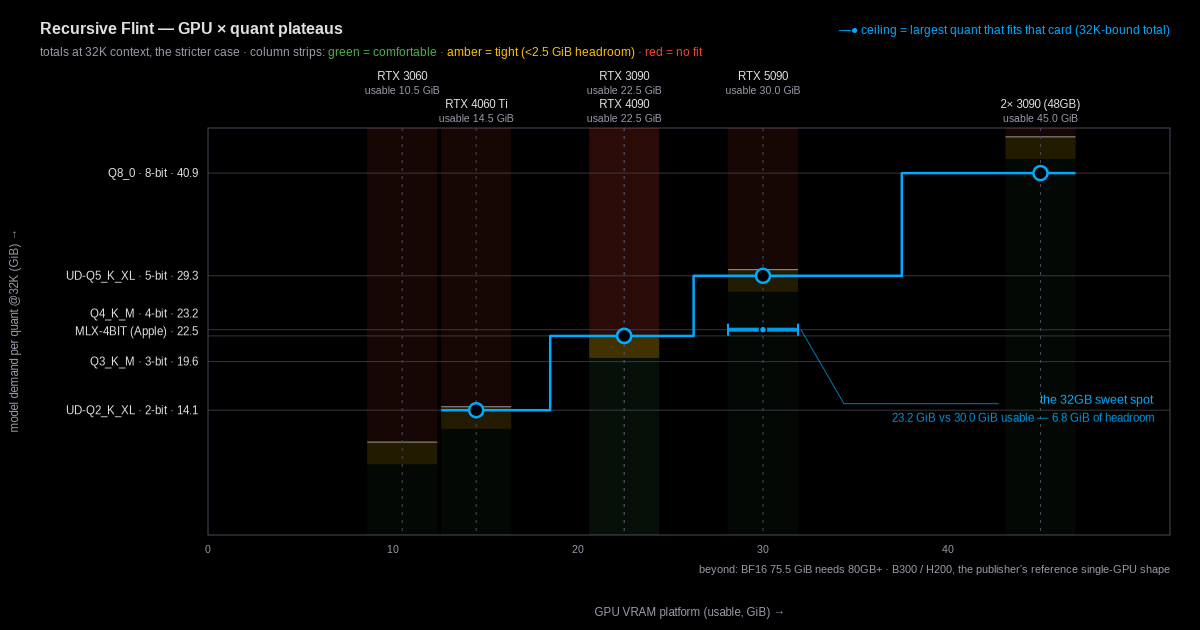
How much VRAM at each quantization? (listed file size + runtime allowance + 32K KV)
| Quantization | VRAM needed @32K | KV @32K reported i · already in the left column | Smallest tracked fit (context noted) | Note |
|---|---|---|---|---|
| UD_IQ1_M | 12.0 GiB | 0.9605 GiB | RTX 4060 Ti 16GB | listed file size 10.6 GiB · estimated total includes 32K KV |
| UD_Q2_K_XL | 14.1 GiB | 0.9605 GiB | RTX 4060 Ti 16GB | listed file size 12.6 GiB · estimated total includes 32K KV |
| Q3_K_M | 19.6 GiB | 0.9605 GiB | RTX 3090 24GB | listed file size 18.2 GiB · estimated total includes 32K KV |
| IQ4_XS | 22.4 GiB | 0.9605 GiB | RTX 3090 24GB | listed file size 20.9 GiB · estimated total includes 32K KV |
| MLX_4BIT | 22.5 GiB | 0.9605 GiB | — | listed file size 21.0 GiB · estimated total includes 32K KV |
| NVFP4 | 22.8 GiB | 0.9605 GiB | RTX 3090 24GB · ≤~23K ctx | listed file size 21.3 GiB · estimated total includes 32K KV |
| Q4_K_M | 23.2 GiB | 0.9605 GiB | RTX 5090 32GB | listed file size 21.8 GiB · estimated total includes 32K KV |
| UD_Q5_K_XL | 29.3 GiB | 0.9605 GiB | RTX 5090 32GB | listed file size 27.9 GiB · estimated total includes 32K KV |
| Q8_0 | 40.9 GiB | 0.9605 GiB | 2× RTX 3090 24GB (48GB aggregate) | listed file size 39.4 GiB · estimated total includes 32K KV |
GB vs GiB: totals here are GiB (230 bytes), and a card sold as "24GB" holds 24 GiB of VRAM, about 22.5 of them usable. GB appears only for the download size, where it is decimal: the Q4_K_M file is 23,387,911,136 B — 23.39 GB to download, 21.8 GiB once it is on the card, a 7% gap.
The 48GB-class doors, spelled out: a dual-GPU combo (2× 24GB; not one card doubled), a workstation card (RTX 6000 Ada), or a Mac Studio (unified memory; runs, slower tok/s). On this model they matter for Q8_0 (40.9 GiB) and for the BF16 reference build (75.6 GiB), which needs 80GB+ — a B300 or H200, the shape Recursive's serving kit assumes.
How this page computes the numbers (reproduce any cell)
- usable VRAM = nominal minus reserve, per card: 12GB → 10.5 GiB, 16GB → 14.5 GiB, 24GB → 22.5 GiB, 32GB → 30.0 GiB, 2× RTX 3090 24GB (48GB aggregate) → 45.0 GiB.
- total@32K = listed file size + provisional runtime allowance + KV@32K; KV@32K = 0.9605 GiB (config-derived estimate under llama.cpp’s default allocation (single sequence, n_ubatch=512 → 1,280 cells) — 31,474 B/token effective at 32K; larger ubatch, parallel sequences or --swa-full allocate more; composition in sources)
- total@32K (main column) = listed file size + provisional runtime allowance + config-derived KV@32K. The 4K figures in the FAQ are a secondary comparison scenario, not a runtime default.
- The "≤~XK ctx" note = 8K + 32K × (usable − total@8K) ÷ KV@32K — the context length that exactly fills the card (KV grows linearly with context on this model).
- A build fits a card at 32K when total@32K ≤ usable; tight = under 2.5 GiB of headroom, one site-wide threshold.
Is your GPU enough? (find your card: one row tells you)
| Your GPU | VRAM | Biggest quant that fits (ceiling) | How it feels |
|---|---|---|---|
| RTX 3060 12GB | 12 GB | — | — |
| RTX 4060 Ti 16GB | 16 GB | UD_Q2_K_XL (2-bit) · 14.1 GiB | 0.4 GiB spare at 32K (KV counted) |
| RTX 3090 24GB | 24 GB | IQ4_XS (4-bit) · 22.4 GiB | 0.1 GiB spare at 32K (KV counted) |
| RTX 4090 24GB | 24 GB | IQ4_XS (4-bit) · 22.4 GiB | 0.1 GiB spare at 32K (KV counted) |
| RTX 5090 32GB | 32 GB | UD_Q5_K_XL (5-bit) · 29.3 GiB | 0.7 GiB spare at 32K (KV counted) |
| 2× RTX 3090 24GB (48GB aggregate) | 48 GB | Q8_0 (8-bit) · 40.9 GiB | 4.1 GiB spare at 32K (KV counted) |
Quants stack by size: each GPU has exactly one ceiling — a card that runs a bigger build runs every smaller one. Main-column totals price the full 32K load; each row's Note prices the full 32K load this page promises (Q4_K_M at 32K = 23.2 GiB), and CPU offload trades tok/s for headroom.
What GPU should you buy for it? (the 32GB sweet spot logic)
| The logic | 32GB is the lowest-priced tier that runs the community-default Q4 at full context: 23.2 GiB against 30.0 GiB usable, 6.8 GiB to spare. Below it a 24GB card has to pick a tradeoff — Q3_K_M keeps the full 32K comfortably at 19.6 GiB (2.9 spare), IQ4_XS keeps a 4-bit build at 22.4 GiB (0.1 spare, tight), and Q4_K_M clears the line only under about 5.2K tokens of context (22.5 GiB at 4K, 22.58 GiB at 8K against 22.5 usable). 16GB holds 2-bit builds only; 12GB has no door among tracked builds at the fully-GPU baseline. Above 32GB, the 2× 3090 tier buys Q8_0 (40.9 GiB, 4.1 spare; a single 6000 Ada leaves 5.6) — nice, not necessary. |
| Why it fits | Q4_K_M is 21.8 GiB of weights; the 32K KV bill is 0.9 GiB because only 14 of the 49 layers are full attention with 4 KV heads — 28,672 bytes per token, the arithmetic this page shows line by line — plus 0.09 GiB of fixed state from the 35 sliding-window layers and 0.5 GiB of runtime overhead. Weights + KV + overhead = 23.2 GiB against 30.0 GiB usable. |
⚠ Tight is a site-wide threshold: under 2.5 GiB of headroom. Q4_K_M @32K leaves 6.8 GiB on a 32GB card — comfortable. The tight fits worth knowing: UD-Q5_K_XL at 29.3 GiB (0.7 spare) on 32GB; on 24GB, IQ4_XS at 22.4 (0.1 spare) and MLX-4BIT at 22.47 (0.03 spare, Apple format); on 16GB, UD-Q2_K_XL at 14.1 (0.4 spare). The near-miss rows: Q5_K_M totals 30.1 GiB — 0.1 GiB over the 32GB card's 30.0 GiB usable; at 24GB, Q4_0 totals 22.7 GiB (0.2 over), NVFP4 22.8 (0.3 over) and Q4_K_M 23.2 (0.7 over). All totals carry the hybrid KV arithmetic, so these verdicts move only when a build, the context, or the KV allocation (ubatch, parallel sequences, --swa-full) changes.
Tracked builds (actual file sizes, not theory)
| Build | Publisher | File size | 24GB @32K | Source |
|---|---|---|---|---|
| UD_IQ1_M | unsloth | 10.6 GiB | OK · 12.0 | HF @20468edf verified |
| UD_Q2_K_XL | unsloth | 12.6 GiB | OK · 14.1 | HF @20468edf verified |
| IQ2_XXS | bartowski | 11.2 GiB | OK · 12.7 | HF @a04b26fb verified |
| Q3_K_M | bartowski | 18.2 GiB | OK · 19.6 | HF @a04b26fb verified |
| IQ4_XS | bartowski | 20.9 GiB | TIGHT · 22.4 | HF @a04b26fb verified |
| MLX_4BIT | RecursiveSI | 21.0 GiB | metal-only | HF @3b93f905 verified |
| NVFP4 | RecursiveSI | 21.3 GiB | NO · 22.8 | HF @6ec43e19 verified |
| Q4_K_M | ggml-org | 21.8 GiB | NO · 23.2 | HF @468307a1 verified |
| Q4_K_M (bartowski) | bartowski | 23.6 GiB | NO · 25.1 | HF @a04b26fb verified |
| Q4_1 | RecursiveSI | 24.2 GiB | NO · 25.7 | HF @9c471510 verified |
| UD_Q5_K_XL | unsloth | 27.9 GiB | NO · 29.3 | HF @20468edf verified |
| Q8_0 | ggml-org | 39.4 GiB | NO · 40.9 | HF @468307a1 verified |
| BF16 | RecursiveSI | 74.1 GiB | NO · 75.6 | HF @2a247be0 verified |
Four publishers, 42 tracked builds, 35 distinct quant names — and the same name does not mean the same bytes. We price ggml-org's Q4_K_M (21.8 GiB) as this page's hero; bartowski's Q4_K_M is 23.6 GiB, 1.8 GiB heavier at the same label, which lands it 25.1 GiB at 32K — still comfortable on a 32GB card, but a different row than the one we quote. Q8_0 and BF16 barely move between publishers (Q8_0 39.40–39.44 GiB from three of them; BF16 74.1–74.2). Q4_1 splits the other way: Recursive's own 24.2 GiB and bartowski's 23.5 GiB are independent builds (different publishers, repos and file bytes) that happen to sit within 4% of each other — the build table keeps the official one as a display choice; both stay in the candidate universe and no percentage threshold collapses same-name builds. Recursive also ships two builds no community publisher matches: an NVFP4 GGUF (21.3 GiB) for CUDA, with the publisher recommending at least 48 GB of GPU memory for its 262,144-token launch settings, and an MLX INT4 (21.0 GiB, group-64 affine) for Apple Silicon through its own Rec engine. The official BF16 repo is 15 shards, 79,575,138,056 B — 74.1 GiB — and the SGLang kit prices one B300 or H200 per replica, not the single-card tier.
Self-host or API?
Estimate owned-GPU vs API breakeven
This is a token-cost sensitivity exercise, not a purchase recommendation. The model still has to meet your quality and throughput needs.
Worked example: a $1,200 GPU kept 30 months plus 350W for 4 hours/day at $0.15/kWh costs about $46 per month. OpenRouter lists a free API variant, so there is no paid-API breakeven to compare.
| Input | Value |
|---|---|
Monthly cost $46 · Breakeven tokens/month —
The static defaults and the script use the same formula. Nothing leaves this page.
Formula and evidence
| Monthly hardware cost | GPU price ÷ months you keep it |
| Monthly electricity | average watts × hours/day × 30 ÷ 1000 × your kWh price |
| Breakeven usage | (hardware + electricity) ÷ blended API price per 1M tokens |
OpenRouter lists recursive/flint-v1.0:free at $0.00 input / $0.00 output per 1M tokens in the 2026-10-31 snapshot; no finite paid-API breakeven is claimed. The $1,200 GPU input is an editable example, not a market quote. Check the live provider page before committing budget. OpenRouter free variant
Where every number comes from (every figure carries its tag)
Totals: measured weights + KV as config arithmetic (14 full-attention layers growing, 35 sliding-window layers at a fixed state — labeled; an estimate under the default allocation, not a bound at larger ubatch or --swa-full) + a borrowed provisional allowance (507 MiB from a Gemma 2 9B / 4K / FA-off log; unverified for this model). This page exists for one config: the 40B-A2.5B MoE × Q4_K-class quant × 32K context — the configuration where a 24GB card runs out of Q4 room even at 8K and 32GB becomes the cheapest comfortable answer.
| Tag | Slot | What it is | What the verdict can claim |
|---|---|---|---|
| reported | model | Hugging Face config.json @2a247be0 (identity: 49 layers, 32 query heads, 4 KV heads, head dim 128, 35 sliding-window + 14 full-attention layers, window 513, 262,144 max positions; the source for every architecture figure on this page) | Tight, conditional — stands on the linked source, re-checkable by you. |
| reported | static | Hugging Face model page (RecursiveSI/flint pinned README — model specification table, publisher benchmarks, SGLang serving kit for one B300 or H200 per replica) | Tight, conditional — stands on the linked source, re-checkable by you. |
| measured | static | unsloth GGUF repo tree @20468edf — 8 Dynamic quants from UD-IQ1_M (11,352,241,600 B) to UD-Q6_K_XL plus Q8_0 and BF16 (10 files); the 2-bit door on 16GB and the 32GB ceiling both come from here | Pinned fact — the file measurement is checkable; runtime is not measured. |
| measured | static | bartowski GGUF repo tree @a04b26fb — 25 quant files from IQ2_XXS (12,029,007,072 B) to BF16; every bartowski weights byte on this page comes from here | Pinned fact — the file measurement is checkable; runtime is not measured. |
| measured | static | ggml-org GGUF repo tree @468307a1 — three files: Flint-Q4_K_M.gguf 23,387,911,136 B (this page's hero build), Flint-Q8_0.gguf 42,350,359,520 B, Flint-BF16.gguf 79,625,761,760 B | Pinned fact — the file measurement is checkable; runtime is not measured. |
| measured | static | Official int4 GGUF repo tree @9c471510 — flint-int4-q4_1.gguf 25,992,966,976 B; publisher notes Apple Silicon with 48 GB unified memory and llama.cpp flags --cache-ram 0 -b 256 -ub 128 -t 8 | Pinned fact — the file measurement is checkable; runtime is not measured. |
| measured | static | Official NVFP4 GGUF repo tree @6ec43e19 — flint-nvfp4.gguf 22,863,084,160 B; publisher recommends at least 48 GB of GPU memory for its 262,144-token launch settings (-c 262144 -fa on -ctk f16 -ctv f16) and lists B300 / RTX PRO 6000 Blackwell / RTX Spark / DGX Spark as tested | Pinned fact — the file measurement is checkable; runtime is not measured. |
| measured | static | Official MLX INT4 repo tree @3b93f905 — five safetensors shards, 22,568,912,600 B total (group-64 affine INT4 with INT8 embeddings), run through Recursive's own Rec engine, not llama.cpp | Pinned fact — the file measurement is checkable; runtime is not measured. |
| measured | static | Official safetensors tree @2a247be0 — 15 shards, 79,575,138,056 B = 74.11 GiB bf16 (79.58 GB, the "about 80 GB" download the model card quotes) | Pinned fact — the file measurement is checkable; runtime is not measured. |
| reported | kv | KV cache @32K — no published memory measurement for Flint in our sources (searched 2026-10-27, six days after the 2026-10-21 release); the page shows config arithmetic instead: 28,672 B/token × 32,768 tokens = 0.875 GiB on the 14 full-attention layers (14 × 4 KV heads × 128 dim × K and V × 2 bytes bf16) plus 0.0855 GiB of sliding-window state from the 35 window-513 layers, derived from the pinned config.json — an estimate under the default allocation; quantized KV only shrinks it | Tight, conditional — stands on the linked source, re-checkable by you. |
| provisional | overhead | Deployment overhead — borrowed allowance from a Gemma 2 9B / 4K / FA-off log (0.4951 GiB; provisional, not measured on this model) | Very likely right, order of magnitude only — replaced the moment measured values land. |
| reported | static | Recursive release post "Introducing Recursive Flint" (2026-10-21) — release date, 40B total / 2.5B active framing, benchmark scores (54.9% Terminal-Bench 2.1, 89.7% SWE-bench Pro v2, 74.2% SWE-bench Verified) and the throughput claims, all measured on Recursive's own engine rather than llama.cpp | Tight, conditional — stands on the linked source, re-checkable by you. |
FAQ
Does Flint fit in 24GB VRAM?
Not at Q4_K_M beyond a short context. The ggml-org build totals 23.2 GiB at 32K against 22.5 GiB usable, and the door closes early: at 4K it is 22.5 GiB (about 0.03 GiB to spare), by 8K it is 22.58 GiB, 0.08 GiB over the line — the fit runs out around 5.2K tokens. A 24GB card still runs Flint three ways: Q3_K_M at the full 32K (19.6 GiB, 2.9 to spare — comfortable), IQ4_XS at the full 32K (22.4 GiB, 0.1 to spare — tight), or the MLX-4BIT build (22.47 GiB, 0.03 to spare) if you are on Apple silicon rather than CUDA. A 32GB card (30.0 GiB usable) is the first tier that holds Q4_K_M comfortably: 23.2 GiB, 6.8 GiB to spare.
How much VRAM does Flint need at Q4_K_M?
23.2 GiB at a 32K context on the ggml-org build: 21.8 GiB of weights + 0.5 GiB of runtime overhead + 0.96 GiB of KV. The KV figure is config arithmetic for this hybrid model — 28,672 bytes per token on the 14 full-attention layers (14 layers × 4 KV heads × 128 head dim × K and V × 2 bytes) × 32,768 tokens = 0.875 GiB, plus 0.09 GiB of fixed state from the 35 sliding-window layers (a 513-token window each). It is a config-derived estimate under llama.cpp's default allocation (single sequence, n_ubatch=512 → 1,280 cells), not a memory measurement; quantized KV only shrinks it, while a larger ubatch, parallel sequences or --swa-full allocate more. At 4K the KV term falls to about 0.19 GiB and the same build loads in about 22.5 GiB; at the documented 256K context it grows to 7.1 GiB and the total reaches 29.4 GiB.
Which GPU runs Flint at a 32K context?
32GB: Q4_K_M at 23.2 GiB (6.8 to spare) or UD-Q5_K_XL at 29.3 GiB (0.7 to spare, tight). 48GB-class hardware (2× RTX 3090 or RTX 6000 Ada: 2× 3090 = 45.0 GiB usable; a single 6000 Ada = 46.5 GiB) holds Q8_0 at 40.9 GiB, 4.1 to spare. 24GB tops out at 22.4 GiB on IQ4_XS (0.1 to spare, tight); the MLX-4BIT build (22.47 GiB, 0.03 to spare) is Apple-only and is not an NVIDIA door; the comfortable 24GB pick is Q3_K_M at 19.6 GiB. 16GB reaches UD-Q2_K_XL at 14.1 GiB (0.4 to spare, tight), and 12GB has no door at the fully-GPU baseline: the smallest tracked build, UD-IQ1_M, is 12.0 GiB at 32K against 10.5 GiB usable.
Does Flint run on a 16GB card?
At 32K, only at 2-bit. UD-Q2_K_XL totals 14.1 GiB against 14.5 GiB usable — 0.4 to spare, tight by this site's 2.5 GiB threshold; UD-IQ1_M totals 12.0 GiB and is the only comfortable fit on that card (2.5 to spare). At 8K the door opens one step: UD-IQ3_XXS totals 14.29 GiB against 14.5 GiB usable (0.4 to spare, tight). 12GB has no door at either context among tracked builds at the fully-GPU baseline — UD-IQ1_M at 8K is 11.3 GiB against 10.5 GiB usable.
How big is Flint's KV cache?
0.96 GiB at 32K in bf16 — and that is the whole architectural point: only 14 of the 49 layers are full attention, so the growing part runs at 28,672 bytes per token (14 layers × 4 KV heads × 128 head dim × 2 for K and V × 2 bytes) — 0.30 GiB at 8K, 0.96 GiB at 32K, 7.1 GiB at the full 256K — while the 35 sliding-window layers hold a fixed 0.09 GiB whatever the context. Compare a dense 33B of the same head width — Nanbeige4.3-33B runs 52 layers with 8 KV heads, Flint 49 layers with 4: it grows at 212,992 bytes per token and pays 6.5 GiB at 32K. Context is still the budget knob — an fp8 or quantized KV cache shrinks the linear part — but on Flint it costs roughly a seventh of what a dense model of this size would.
What GGUF quants exist for Flint, and what license is it under?
Apache-2.0, and the community ladder filled in fast: unsloth published 8 Dynamic builds from UD-IQ1_M (10.6 GiB) up, plus Q8_0 and BF16 (10 files in all), bartowski 25 files from IQ2_XXS (11.2 GiB) to BF16, and ggml-org a three-file set (Q4_K_M 21.8 GiB, Q8_0 39.4, BF16 74.2) — all inside the first two days of the 2026-10-21 release; unsloth's repo has drawn 125,188 downloads. Recursive ships its own NVFP4 (21.3 GiB), an int4 GGUF (Q4_1, 24.2 GiB, for Apple Silicon with 48 GB unified memory) and an MLX INT4 (21.0 GiB, run through its own Rec engine). Same name, different bytes: Q4_K_M is 21.8 GiB from ggml-org and 23.6 GiB from bartowski — 1.8 GiB heavier at the same label — while Q8_0 and BF16 are nearly identical across publishers. The official repo is BF16 only (15 shards, 74.1 GiB) with an SGLang kit for one B300 or H200 per replica.