GLM-5.3-Flash VRAM requirements
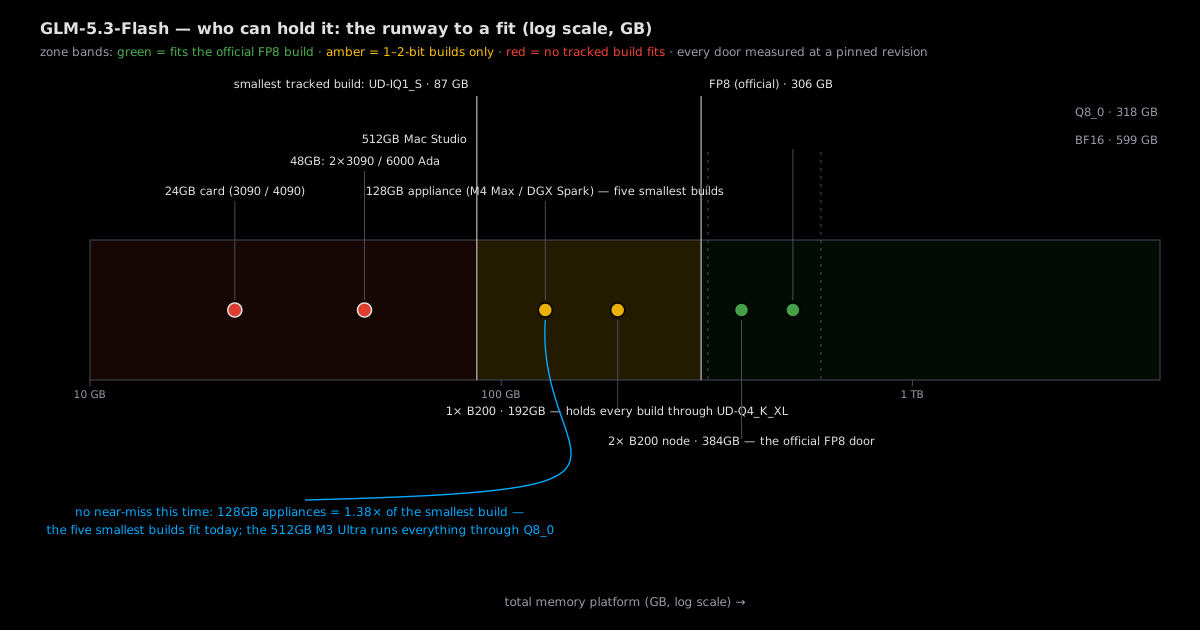
GLM-5.3-Flash's smallest measured build is unsloth's UD-IQ1_S, 1-bit. Unlike most cliff-class models, the appliance door is real this time: a single 512GB Mac Studio runs every tracked build through 318.1 GiB Q8_0, and 1× B200-class holds the 1-bit door on rented metal. The official FP8 build (306.3 GiB) needs 2× B200; everyone else should take the API.
Updated · data status: MEASURED WEIGHTS — totals = measured weights + deployment overhead (KV not counted: linear state unmeasured); every weight is a pinned file-size sum (unsloth / antirez / RedHatAI / orcarouter / zai-org)
Rent it: minimal cloud configs (the smallest door in)
| Quantization | Total VRAM | Minimal single-node config | Verdict |
|---|---|---|---|
| UD-IQ1_S (measured) | 87.2 GiB | 1× B200 / 1× MI300X | EXTREME · 1-bit trade-off |
| UD-IQ1_M (measured) | 91.4 GiB | 1× B200 / 1× MI300X | EXTREME · steeper trade-off |
| UD-IQ2_XXS (measured) | 95.3 GiB | 1× B200 / 1× MI300X | EXTREME · 2-bit dynamic |
| UD-Q2_K_XL (measured) | 101.7 GiB | 1× B200 / 1× MI300X | EXTREME · 2-bit dynamic |
| UD-IQ3_XXS (measured) | 112.6 GiB | 1× B200 / 1× MI300X | EXTREME · 3-bit dynamic |
| NVFP4 (RedHatAI) | 177.7 GiB | 1× B200 / 1× MI300X | single-node door · NVIDIA format |
| Q4_K (antirez GGUF) | 178.3 GiB | 1× B200 / 1× MI300X | single-node door |
| FP8 (official zai-org) | 306.3 GiB | 2× B200 / 2× MI300X | the official-precision door |
| Q8_0 | 318.1 GiB | 2× B200 / 2× MI300X | 2-GPU territory |
Card counts are plain division (rounded up) against published per-GPU memory (B200 192GB, MI300X 192GB) on measured totals — a weights-plus-overhead floor: KV is deliberately not counted (GLM-5.3-Flash's linear-attention state has no in-source measurement), so treat each total as a floor, not a ceiling. No consumer GPU appears in this table because none comes close — that is said once, in the verdict above, not row by row.
Appliance / unified-memory form factors
| Appliance | Unified memory | Best fit | Verdict |
|---|---|---|---|
| Mac Studio M3 Ultra | 512 GB | every build through Q8_0 (318.1 GiB) fits — 5.54× of smallest (usable), a real door | FITS · 1-bit through Q8_0 |
| Mac Studio M4 Max | 128 GB | five smallest builds fit (UD-IQ1_S → UD-IQ3_XXS, 87.2–112.6 GiB) — 1.38× of smallest | EXTREME · 1–3-bit doors only |
| NVIDIA DGX Spark | 128 GB | five smallest builds fit (UD-IQ1_S → UD-IQ3_XXS, 87.2–112.6 GiB) — 1.38× of smallest | EXTREME · 1–3-bit doors only |
The appliance column is a real exit for this model, not a footnote: even the largest unified-memory appliance (512GB, usable 480 GiB) reaches 5.54× of the smallest tracked build — a measured 86.7 GiB unsloth UD-IQ1_S file — and holds every build through 318.1 GiB Q8_0. The 128GB boxes (usable 120 GiB, 1.38×) clear the five smallest builds (87.2–112.6 GiB). Ratios compare usable memory to the build's file size, both figures in GiB (binary) — the division is computed and checked in a single unit end to end, so decimal-GB rereadings of these numbers do not apply; throughput on unified memory trails datacenter GPUs by an order of magnitude, so these are "it runs" verdicts, not "it runs fast".
Can't run it? The distill / step-down ladder
No official GLM-5.3-Flash distills yet. The family's own history points at what happens next: Zhipu has shipped smaller Flash siblings before, and a 5.3-Flash distill or step-down sibling would instantly become the family's consumer entry — this ladder's 1-bit doors exist, but a native small model beats a 1-bit 320B every time. When official distills or smaller siblings ship, each gets its own VRAM page and this section links the full ladder.
Step-down options that exist: GLM-4.7-Flash — not yet tracked on this site.
Private deployment (enterprises, labs, providers)
A separate query family from everything above: vLLM / SGLang tensor-parallel reference configs for GLM-5.3's DSA/KDA attention stack, compliance and air-gapped deployments, TCO modeling against the API. The buyers here are not price-shopping against the API: regulated workloads (health, finance, government), data-residency rules, and air-gapped labs make self-hosting a procurement requirement, not an optimization. A cheap or free API does not erase private-deployment demand — it just raises the bar for when self-hosting is rational.
Or just use the API
Honest take: GLM-5.3-Flash is a 320.0 B MoE with 18.0 B active parameters — precisely the shape where hosted APIs are cheapest to run and hardest to beat on cost. Self-hosting makes sense when private deployment is the requirement, not to save money. Prices are linked, not pinned, because they differ by provider and over time.
Where every number comes from (every figure carries its tag)
| Tag | Slot | What it is | What the verdict can claim |
|---|---|---|---|
| measured | Build file sizes | Community + official quant files, sizes summed at pinned revisions (unsloth GLM GGUF, antirez Q4_K, RedHatAI NVFP4, orcarouter MLX, zai-org FP8/BF16 — linked below). | Determinate at each door — a platform above or below a measured file size is a fact, not an estimate. |
| provisional | Totals (weights + overhead) | Simple addition: measured weights + a linked deployment-overhead anchor (llama.cpp discussion #9936). KV is deliberately not counted — GLM-5.3-Flash's linear-attention (KDA) state has no in-source measurement, and a half-grid KV would dress totals up as complete. | Totals are floors — real usage sits higher once KV lands; the order of magnitude and every door verdict don't move. |
| provisional | Cloud card counts | Simple division against published per-GPU memory (B200 192GB, MI300X 192GB — linked below). | Card counts follow arithmetically once totals are set. |
| reported | API prices | Referenced from OpenRouter, linked, not re-verified by us. | Tracks the linked page — prices move, we don't pin them. |
| unsloth/GLM-5.3-Flash-GGUF @ 621d456e (UD-IQ1_S 86.7GiB / UD-IQ1_M 90.9GiB / UD-IQ2_XXS 94.9GiB / UD-Q2_K_XL 101.3GiB / UD-IQ3_XXS 112.1GiB / Q8_0 317.6GiB) | pinned tree | accessed 2026-09-21 |
| antirez/glm-5.3-flash-gguf @ b2fa29d7 (Q4_K 177.8GiB) | pinned tree | accessed 2026-09-01 |
| RedHatAI/GLM-5.3-Flash-NVFP4 @ 36c184c6 (NVFP4 177.2GiB) | pinned tree | accessed 2026-09-01 |
| zai-org/GLM-5.3-Flash @ eb9eb208 (official FP8 305.8GiB) | pinned tree | accessed 2026-09-21 |
| ggml-org/llama.cpp discussion #9936 (runtime overhead anchor) | measured | accessed 2026-09-05 |
| NVIDIA B200 spec (192GB) | product page | accessed 2026-09-08 |
| AMD MI300X spec (192GB) | product page | accessed 2026-09-08 |
| OpenRouter — GLM-5.3-Flash prices | live | accessed 2026-09-08 |
| orcarouter/GLM-5.3-Flash-MLX (MLX build, 190.0 GiB) | measured file listing | accessed 2026-09-01 |
| zai-org/GLM-5.3-Flash-BF16 (official BF16, 598.5 GiB → 599.0 total) | measured file listing | accessed 2026-09-21 |
FAQ
Can GLM-5.3-Flash run on an RTX 4090?
No. The smallest measured build (unsloth UD-IQ1_S) totals 87.2 GiB — 3× the 24GB on a 4090. The realistic paths are renting cloud GPUs, a 512GB Mac Studio, or the API.
Can GLM-5.3-Flash run on an RTX 5090 or 2x RTX 6000 Ada?
No for any single consumer card: a 32GB RTX 5090 falls ~3× short of the 87.2 GiB smallest build. The ~96GB pair of RTX 6000 Ada cards is the interesting edge — the smallest build is 0.9× of the pair's combined memory, so it loads on paper; in practice, splitting a 1-bit MoE across two gaming cards is a science project, not a setup.
Can a Mac Studio run GLM-5.3-Flash?
Yes — unusually for a 100B+ model. The 512GB M3 Ultra (480 GiB usable) runs every tracked build through the 318.1 GiB Q8_0; the 128GB boxes (M4 Max / DGX Spark, ~120 GiB usable) run the five smallest builds (87.2–112.6 GiB). Unified-memory bandwidth caps throughput, so treat these as "it runs" verdicts.
How many GPUs do you need to run GLM-5.3-Flash?
At the smallest measured build (87.2 GiB): 1× B200 (192GB each). At the official FP8 build (306.3 GiB): 2×. At Q8_0 (318.1 GiB): 2×; at BF16 (599.0 GiB): 4×. Single-node rental configs; card counts are plain division on measured totals.
Is there a smaller version of GLM-5.3-Flash?
No official distills yet. The family has shipped smaller Flash siblings before (GLM-4.7-Flash — not yet tracked on this site) — when a 5.3-Flash distill or sibling lands it becomes the practical consumer entry, and this page will link it.