Kimi K3 VRAM requirements
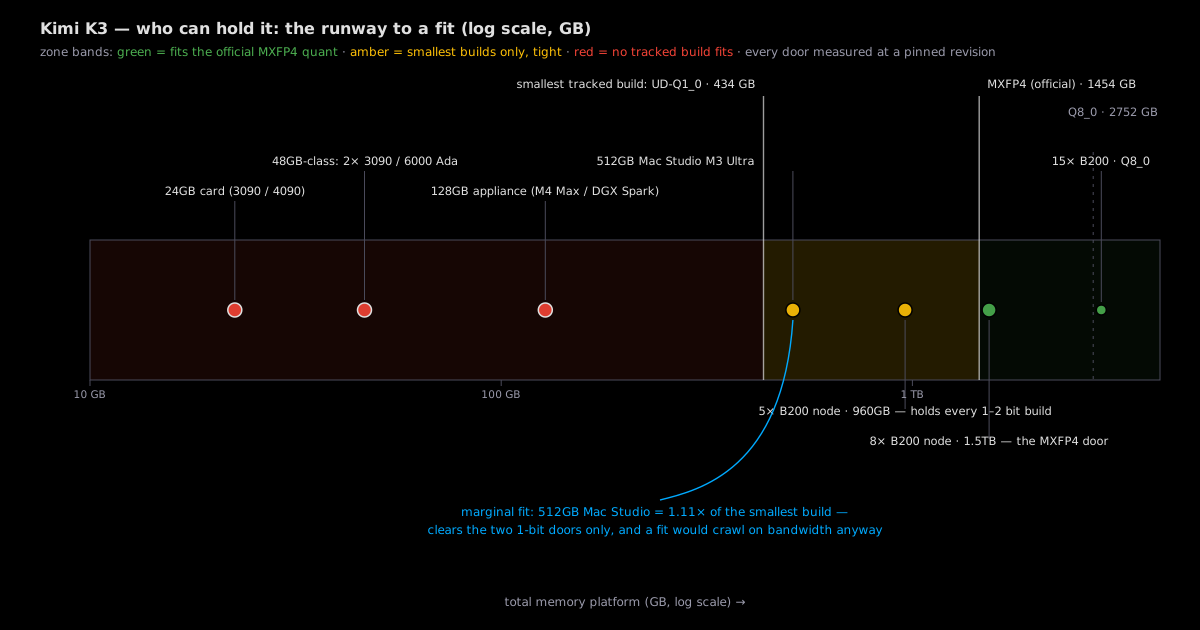
Kimi K3's smallest measured build is unsloth's UD-Q1_0, a true 1-bit file. Renting a single cloud node is the smallest door in — 3× B200-class holds the 1-bit door, 8× holds the official MXFP4 quant; the 512GB Mac Studio just clears the two smallest 1-bit builds; everyone else should take the API or wait for a distill.
Updated · data status: MEASURED WEIGHTS — every door is a file-size sum at a pinned revision (unsloth / AtomicChat / official MXFP4 & NVFP4); KV rides a linked empirical estimate at 32K
Rent it: minimal cloud configs (the smallest door in)
| Quantization | Total VRAM | Minimal single-node config | Verdict |
|---|---|---|---|
| UD-Q1_0 (measured) | 435.9 GiB | 3× B200 / 3× MI300X | EXTREME · 1-bit trade-off |
| IQ1_S (measured) | 550.6 GiB | 3× B200 / 3× MI300X | EXTREME · steeper trade-off |
| IQ1_M (measured) | 644.1 GiB | 4× B200 / 4× MI300X | EXTREME · steeper trade-off |
| MXFP4 (official) | 1455.3 GiB | 8× B200 / 8× MI300X | the official-quant door |
| NVFP4 (official) | 1500.9 GiB | 8× B200 / 8× MI300X | the Blackwell-native door |
| FP8-BLOCK | 2627.8 GiB | 14× B200 / 14× MI300X | multi-node territory |
| Q8_0 | 2753.6 GiB | 15× B200 / 15× MI300X | multi-node territory |
Card counts are plain division (rounded up) of the GiB totals against published per-GPU GB memory (B200 192GB, MI300X 192GB) on measured totals — a weights-plus-KV floor at 32K: KV rides a linked empirical estimate, and 1024K-context KV stays excluded until the architecture is disclosed. No consumer GPU appears in this table because none comes within an order of magnitude — that is said once, in the verdict above, not row by row.
Appliance / unified-memory form factors
| Appliance | Unified memory | Best fit | Verdict |
|---|---|---|---|
| Mac Studio M3 Ultra | 512 GB | UD-Q1_0 + UD-TQ1_0 fit — 1.11× of smallest (usable), nearest any box gets | MARGINAL · 1-bit doors only |
| Mac Studio M4 Max | 128 GB | none fits — 0.28× of smallest build | NO |
| NVIDIA DGX Spark | 128 GB | none fits — 0.28× of smallest build | NO |
Even the largest unified-memory appliance (512GB, usable 480 GiB) reaches just 1.11× of the smallest tracked build — a measured 434.3 GiB unsloth UD-Q1_0 file (raw file bytes; the 435.9 GiB build total above adds a linked KV-cache estimate and runtime overhead) — clearing only the two 1-bit doors (UD-Q1_0, UD-TQ1_0) at extreme quality cost, and it would crawl on memory bandwidth anyway. Ratios compare usable memory to the build's file size, both figures in GiB (binary) — the division is computed and checked in a single unit end to end, so decimal-GB rereadings of these numbers do not apply. For models that fit these boxes comfortably, see the appliance hub.
Can't run it? The distill / step-down ladder
No official Kimi K3 distills yet. Historically this ladder becomes the family's biggest consumer entry on release week — "distill" queries run several times the "run locally" volume for frontier models. The recent precedent: when DeepSeek R1 shipped, its distilled variants (Qwen- and Llama-based, 1.5B through 70B) arrived in the same window and became the way most self-hosters actually ran it. When official distills or smaller siblings ship, each gets its own VRAM page and this section links the full ladder.
Step-down options that exist: the family's prior Kimi K2 — not yet tracked on this site.
Private deployment (enterprises, labs, providers)
A separate query family from everything above: vLLM tensor-parallel reference configs, compliance and air-gapped deployments, TCO modeling against the API. The buyers here are not price-shopping against the API: regulated workloads (health, finance, government), data-residency rules, and air-gapped labs make self-hosting a procurement requirement, not an optimization. A cheap or free API does not erase private-deployment demand — it just raises the bar for when self-hosting is rational.
Or just use the API
Honest take: at frontier API prices, self-hosting Kimi K3 almost never breaks even unless you need private deployment — a multi-GPU node rents for more per month than most teams' entire API bill. Prices are linked, not pinned, because they differ by provider and over time.
Where every number comes from (every figure carries its tag)
| Tag | Slot | What it is | What the verdict can claim |
|---|---|---|---|
| measured | Build file sizes | Community + official quant files, sizes summed at pinned revisions (unsloth / AtomicChat GGUF, official MXFP4, RedHatAI FP8, NVIDIA NVFP4 — linked below). | Determinate at each door — a platform above or below a measured file size is a fact, not an estimate. |
| reported | KV cache | Linked empirical estimate (particula.tech sizing writeup) at the page's f16/bf16 caliber, 32K — arithmetic from published constants; 1024K-context KV stays excluded until the architecture is disclosed. | Totals move with the KV estimate — the order of magnitude doesn't. |
| provisional | Cloud card counts | Simple division against published per-GPU memory (B200 192GB, MI300X 192GB — linked below). | Card counts follow arithmetically once totals are measured. |
| reported | API prices | Referenced from OpenRouter, linked, not re-verified by us. | Tracks the linked page — prices move, we don't pin them. |
| unsloth/Kimi-K3-GGUF @ a0836360 (UD-Q1_0 434.3 GiB / UD-TQ1_0 474.0 GiB) | pinned tree | accessed 2026-09-01 |
| AtomicChat/Kimi-K3-GGUF @ c204d9f4 (IQ1_S 549.1 GiB / IQ1_M 642.5 GiB / Q8_0 2752.0 GiB) | pinned tree | accessed 2026-09-01 |
| moonshotai/Kimi-K3 @ f831ab66 (official MXFP4 1453.7 GiB) | pinned tree | accessed 2026-09-21 |
| RedHatAI/Kimi-K3-FP8-BLOCK @ 6409c37c (FP8 2626.3 GiB) | pinned tree | accessed 2026-09-21 |
| nvidia/Kimi-K3-NVFP4 @ b2428a0b (NVFP4 1499.4 GiB) | pinned tree | accessed 2026-09-01 |
| particula.tech — Kimi K3 GPU sizing (KV/token empirical) | reported | accessed 2026-09-05 |
| ggml-org/llama.cpp discussion #9936 (runtime overhead anchor) | reported | accessed 2026-09-05 |
| NVIDIA B200 spec (192GB) | product page | accessed 2026-09-02 |
| AMD MI300X spec (192GB) | product page | accessed 2026-09-02 |
| OpenRouter — Kimi K3 prices | live | accessed 2026-09-02 |
FAQ
Can Kimi K3 run on an RTX 4090?
No. The smallest measured build (unsloth UD-Q1_0) totals 435.9 GiB — 18× the 24GB on a 4090. The realistic paths are renting cloud GPUs, the API, or waiting for a distill.
Can Kimi K3 run on an RTX 5090 or 2x RTX 6000 Ada?
No. A 32GB RTX 5090 falls ~14× short; two 48GB RTX 6000 Ada cards (~96GB) fall ~4.5× short of the 435.9 GiB smallest build.
Can a Mac Studio run Kimi K3?
Barely, at the extreme: the 512GB M3 Ultra (480 GiB usable) clears only the two 1-bit doors — the measured 434.3 GiB UD-Q1_0 file (1.11×; raw file bytes, vs the 435.9 GiB build total) and the 474.0 GiB UD-TQ1_0 — and it would crawl on unified-memory bandwidth. No larger build fits.
How many GPUs do you need to run Kimi K3?
At the smallest measured build (435.9 GiB — weights + KV cache + runtime overhead): 3× B200 (192GB each). At the official MXFP4 quant (1455.3 GiB): 8×. At Q8_0 (2753.6 GiB): 15×. Single-node rental configs; card counts are plain division on measured totals.
Is there a smaller version of Kimi K3?
No official distills yet. When they land, the distill ladder becomes the practical consumer entry for this family — watch this page.