Mistral Large 4 VRAM requirements
Mistral Large 4 is a 1T-parameter multimodal MoE with 52B active per token. Its official FP8 tree is 987.7 GiB of weights, while unsloth's lowest UD-IQ1_S package is 217.0 GiB — a real reduction, but still far beyond consumer cards. Architecture is a second bill: MLA stores a compressed latent KV state rather than ordinary per-head KV; this variant also has separate indexer keys and shares latent KV across selected layers. Weight quantization does not determine either cache's size, so a smaller weight file does not imply a proportionally smaller context cost. This page separates capacity from quality: a low-bit file exists, but no runtime quality or speed claim is attached to it. Strata support for the new MistralLarge4ForConditionalGeneration architecture is unverified as of 2026-11-01; the current Strata README lists only its three existing families.
Prepared by LLM VRAM · build · weights measured at pinned revisions, context and overhead explicit · sources below
Updated · data status: MEASURED WEIGHTS — totals = measured weights + config/implementation-derived KV at 32K (2.5586 GiB) + borrowed overhead; every weight is a complete shard-group sum at a pinned revision, never a single shard mistaken for the package
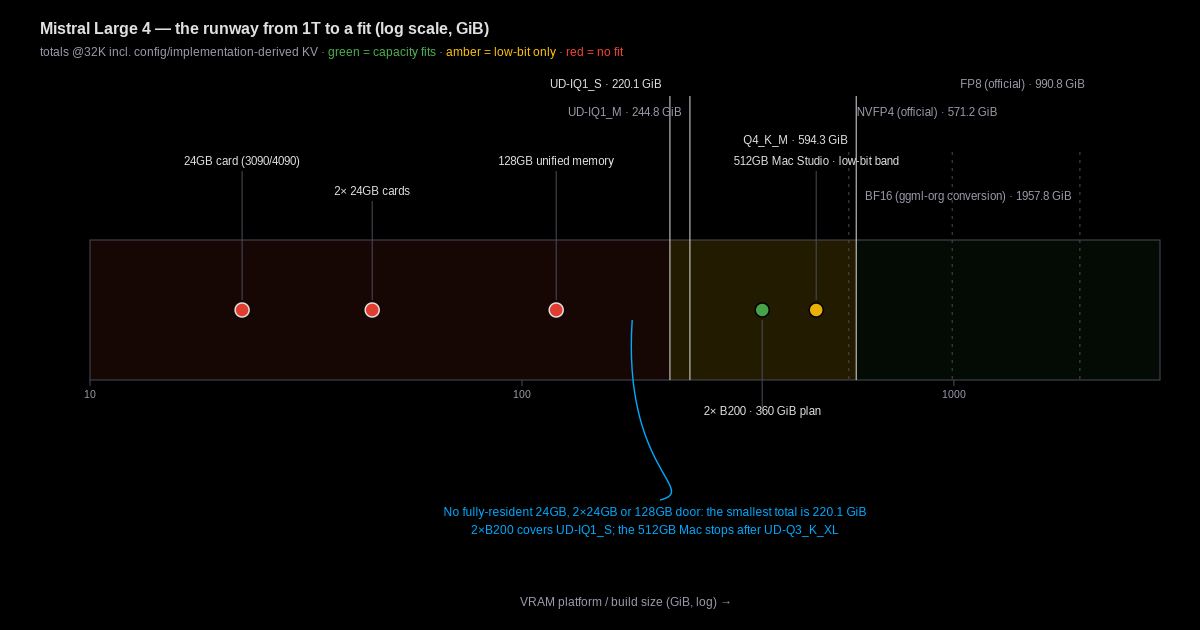
Rent it: cloud capacity floors (the raw files, priced by the card)
| Quantization | 32K total T (floor rows: KV unsized) | Aggregate capacity floor | Verdict |
|---|---|---|---|
| UD-IQ1_S (measured) | 220.1 GiB | 2× B200 / 2× MI300X | smallest complete package · 2×B200 |
| UD-IQ1_M (measured) | 244.8 GiB | 2× B200 / 2× MI300X | next low-bit step · 2×B200 |
| Q4_K_M (measured) | 594.3 GiB | 4× B200 / 4× MI300X | standard 4-bit · 4×B200 |
| NVFP4 (official, measured) | 571.2 GiB | 4× B200 / 4× MI300X | Blackwell-native · 4×B200 |
| FP8 (official, measured) | 990.8 GiB | 6× B200 / 6× MI300X | official FP8 · 6×B200 |
| BF16 (ggml-org conversion) | 1957.8 GiB | 11× B200 / 11× MI300X | community conversion · 11×B200 |
Card counts are ceil(T ÷ 180 GiB) under the site's planning convention, separate from the 192GB hardware label and from any measured runtime-usable budget. The smallest complete package is 220.1 GiB, so it takes two; Q4_K_M takes four, official NVFP4 takes four, and official FP8 takes six. Totals include measured weights, 2.5586 GiB of config/implementation-derived KV at 32K, and a borrowed 0.4951 GiB runtime allowance. They do not include proof of a validated serving configuration.
Appliance / unified-memory form factors
| Appliance | Unified memory | Best fit | Verdict |
|---|---|---|---|
| Mac Studio M3 Ultra | 512 GB | only the low-bit band fits through UD-Q3_K_XL; Q4_K_M, NVFP4, FP8 and BF16 do not | FITS · low-bit only |
| Mac Studio M4 Max | 128 GB | no tracked build fits — even UD-IQ1_S at 220.1 GiB exceeds the raised budget | NO · smallest build misses |
| NVIDIA DGX Spark | 128 GB | no tracked build fits; the macOS budget does not apply to DGX OS, and its working-set budget is unverified here | NO · budget unverified |
The 128GB M4 Max / DGX Spark class has no fully-resident fit: even UD-IQ1_S at 220.1 GiB exceeds the 120 GiB raised macOS budget (96 GiB at the default). The 256GB Mac is only Unsloth's reported UD-IQ1_S boundary, with 256–270GB total-memory guidance; it is not a verified runtime or a measured macOS working-set budget. The 512GB M3 Ultra (480 GiB at the raised limit; 384 GiB at the default) covers only the low-bit band through UD-Q3_K_XL, and Hugging Face reports a Q2_K run at about 90 tok/s prefill and 15 tok/s generation. Q4_K_M, official NVFP4, FP8 and BF16 exceed the 512GB capacity budget. DGX Spark runs NVIDIA DGX OS, and its working-set budget is unverified here — the macOS figures do not apply to it.
Can't run it? The distill / step-down ladder
No official Mistral Large 4 distill is tracked in our 2026-11-01 sources. The useful step-down is Mistral Small 3.1, which has its own page and consumer-sized builds; do not treat it as the same checkpoint. Mistral Large 4 also ships an embedded DSpark speculative-decoding draft head in the official package, but that is not a smaller standalone model or a separate consumer door.
For a real smaller Mistral, see Mistral Small 3.1. It is a different model, not a quant of Large 4.
Private deployment (enterprises, labs, providers)
Production serving is a different question from fitting the files. Mistral documents vLLM and SGLang recipes for this checkpoint, including tensor-parallel serving, while llama.cpp users have GGUF builds from ggml-org and unsloth. The official FP8 package targets 8-way tensor parallelism in the vendor example; this page does not turn that example into a measured node recommendation. A separate split-residency route exists: colibri v2.1.0 reports UD-IQ1_S CUDA decode at 1.34–1.36 tok/s on 62GB RAM, a 24GB RTX PRO 4000 Blackwell SFF and two NVMe drives. That is a community-reported disk-streaming run, not a fully-resident fit or a production-speed promise. The license is the Mistral Ecosystem Open-Weight License, a modified MIT: commercial and non-commercial use is allowed, but operating a Model-as-a-Service business requires a separate commercial license. Read the pinned LICENSE before deploying a hosted service.
Or just use the API
The hosted path is much smaller operationally: OpenRouter lists Mistral Large 4 at $0.70 per million input tokens and $2.10 per million output tokens as of 2026-11-01, with provider and region options shown on the live endpoint page. Choose it when you do not need residency or custom serving. Self-hosting here is for control, not an assumed saving over 2×B200 or a 512GB Mac.
Where every number comes from (every figure carries its tag)
| Tag | Slot | What it is | What the verdict can claim |
|---|---|---|---|
| measured | Build file sizes | Official FP8 and NVFP4 trees, unsloth and ggml-org GGUF ladders, and the MLX 4bit conversion — all summed as complete shard groups at pinned revisions. The smallest package is not one shard: UD-IQ1_S is six files totaling 233,009,564,322 bytes (217.007 GiB). | Byte-level file-size facts; complete package, never a single shard. |
| reported | Model identity and license | Official README: 1T total parameters, 52B active including embeddings and output layers, 128 routed experts with 4 active and 1 shared, 72-layer indexed_attention, 1M context, multimodal input. The LICENSE is a modified MIT with a separate commercial-license requirement for Model-as-a-Service. | Publisher declarations with pinned files; serving quality is a separate claim. |
| provisional | Totals (weights + KV + overhead) | Simple addition: measured weights + config/implementation-derived KV at 32K + a borrowed overhead anchor (llama.cpp #9936). llama.cpp's zero-padded bf16 KV is (63 × (512 + 64) + 44 × 128) × 2 bytes = 83,840 bytes/token, or 2.5586 GiB at 32K. | Runtime-specific estimate, not a runtime memory measurement. |
| provisional | Cloud card counts | Whole-model totals divided by the planning convention of 180 GiB per B200 and rounded up, separate from the 192GB hardware label and any measured runtime-usable budget. Counts are capacity floors, not validated node configurations. | NVFP4 needs four and BF16 needs eleven at this planning budget. |
| reported | Runtime routes | Hugging Face reports Q2_K on one 512GB M3 Ultra at about 90 tok/s prefill and 15 tok/s generation. colibri v2.1.0 reports UD-IQ1_S CUDA decode at 1.34–1.36 tok/s on 62GB RAM, a 24GB RTX PRO 4000 and two NVMe drives. | Named external runs only; the colibri route is disk-streamed split residency, not a fully-resident fit or production recommendation. |
FAQ
What is Mistral Large 4?
Mistral's 1T-parameter multimodal MoE with 52B active per token, released as open weights on 2026-10-29. It has 128 routed experts with 4 active and 1 shared, 72 layers of indexed_attention, a 1M context window, and an embedded DSpark draft head. The official license is a modified MIT: general commercial use is allowed, but a Model-as-a-Service business needs a separate commercial license.
Can a 24GB card or two run it?
Not as a fully-resident fit. The smallest complete UD-IQ1_S package is 217.0 GiB of weights and 220.1 GiB of total, far above one 24GB card's 22.5 GiB usable or two cards' 45.0 GiB usable. A different route does exist: colibri v2.1.0 reports UD-IQ1_S at 1.34–1.36 tok/s on 62GB RAM, one 24GB RTX PRO 4000 and two NVMe drives. That is disk-streamed split residency, not evidence that the full model fits in VRAM or a production-speed recommendation.
What is the smallest practical door?
For full residency, two B200s cover UD-IQ1_S (220.1 GiB) at 180 GiB planned per GPU. A 256GB Mac is only Unsloth's unverified 1-bit boundary; a 512GB Mac Studio covers the low-bit band and has a reported Q2_K run. The Mac's 480 GiB raised budget takes packages through UD-Q3_K_XL, but not Q4_K_M. colibri's 24GB + NVMe route is separate disk streaming, not a fully-resident door.
How much VRAM does Q4_K_M need?
594.3 GiB total, which means four B200s at 180 GiB planned per GPU. Q4_K_M is not a consumer-size answer: even the lower UD-Q3_K_XL is 462.0 GiB, so a 512GB Mac can take that lower step but not Q4_K_M.
How much does context cost?
The 72 indexed_attention layers do not each own a separate cache: 63 own latent KV and 44 own a full indexer, while the others reuse earlier state. For llama.cpp's zero-padded bf16 layout, (63 × (512 + 64) + 44 × 128) × 2 = 83,840 bytes/token, or 2.5586 GiB at 32K. HF uses a narrower NoPE layout, so this is a runtime-specific estimate, not a universal allocator measurement or Mistral Small 3.1's GQA formula. Weight quantization does not set either cache's size.
Does Strata run Mistral Large 4?
We have not found support evidence as of 2026-11-01. The current Strata README lists Qwen3.8-Flash-Next, Qwen3.6-35B-A3B and DeepSeek-V4.1-Flash-1017, but no Mistral Large 4 entry. That is a limited check, not a claim that support cannot arrive; this page does not sell a Strata door until a release or document proves it.
Can I use the hosted API instead?
Yes. OpenRouter's 2026-11-01 endpoint lists Mistral Large 4 at $0.70 per million input tokens and $2.10 per million output tokens. The endpoint page exposes provider and region choices. Hosted access is the operational shortcut when you do not need residency or custom serving.
Is the 1-bit build good enough?
This page does not establish that. UD-IQ1_S is a real, complete package at 217.0 GiB, and 2×B200 has enough capacity for it. That answers a file-size question, not a quality, latency or sustained-throughput question. Evaluate the exact build on your workload before treating it as a production choice.