DeepSeek-V4.1-Flash-1017 VRAM requirements
DeepSeek-V4.1-Flash-1017 is the October 17, 2026 checkpoint of DeepSeek-V4.1-Flash — DeepSeek's own model card calls it a minor update, and then shows benchmark jumps of eleven points on Terminal-Bench 4.0 and nearly three on DeepSWE (both reported, linked below). The supply moved on launch day itself: a lossy-VQ community conversion landed within hours of the checkpoint (as of October 17, 2026) and rewrote the doors — one 128GB appliance (DGX Spark / M4 Max) now fits it at 106.3 GiB with a real quality trade-off (same-top-1 69–79% on the publisher's reference numbers, reported below), one B200 covers the same build for cloud renters, a 512GB Mac Studio runs every standard-precision build through Q4_K_M, and the API is already serving these weights as deepseek-flash. Looking for the previous generation? The DeepSeek-V4-Flash-0731 page prices the V4.0-line files.
Updated · data status: MEASURED WEIGHTS — totals = measured weights + measured overhead anchor; KV kept out of totals (same-day figures: ~890 B/token native reported — under a GiB at 32K against these weights); every weight is a pinned file-size sum (deepseek-ai official + mrfakename + Baekpica, all pinned below)
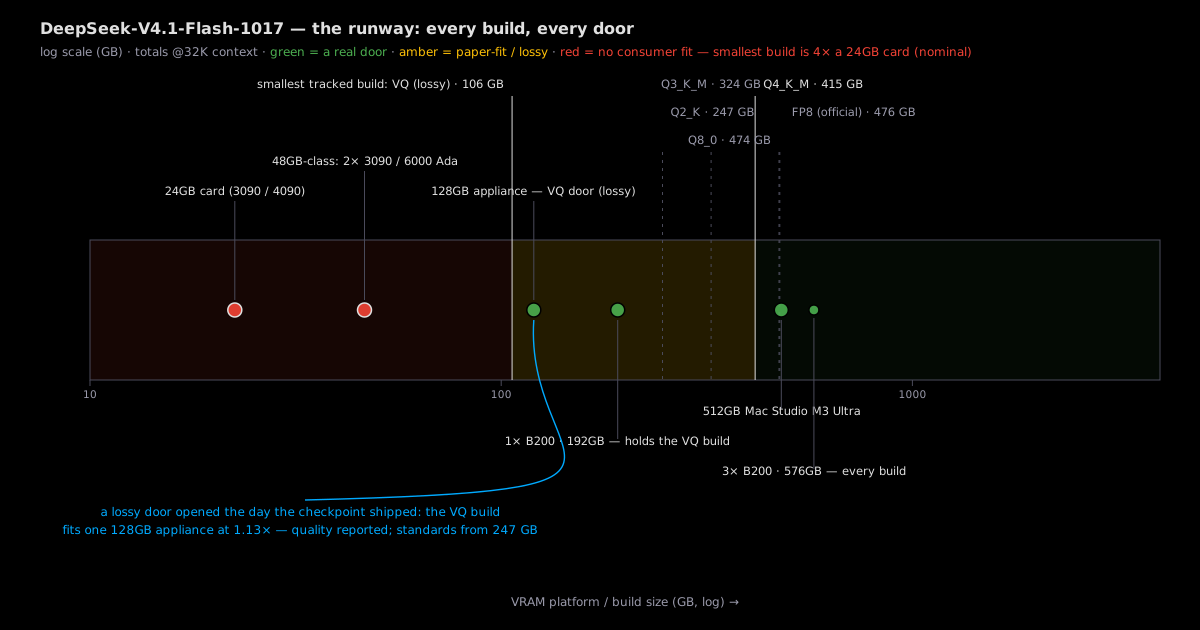
Rent it: minimal cloud configs (the smallest door in)
| Quantization | Total VRAM | Minimal single-node config | Verdict |
|---|---|---|---|
| VQ vq8sh14-q4k (measured · lossy) | 106.3 GiB | 1× B200 / 1× MI300X | smallest build · lossy VQ · as of 2026-10-17: same-top-1 69.08–78.61% (V4.1 same-recipe, reported; 1017-measured pending) · ds4-dfm-rs runtime only |
| Q2_K (measured) | 246.8 GiB | 2× B200 / 2× MI300X | smallest standard-precision build · stock-runnable GGUF |
| Q3_K_M (measured) | 323.9 GiB | 2× B200 / 2× MI300X | community · landed launch day |
| Q4_K_M (measured) | 414.7 GiB | 3× B200 / 3× MI300X | the Q4 door · the standard-precision sweet spot |
| Q8_0 (measured) | 473.6 GiB | 3× B200 / 3× MI300X | community largest · paper-fits one 512GB Mac |
| FP8 (official deepseek-ai) | 475.7 GiB | 3× B200 / 3× MI300X | the official-precision door · 3× B200 |
Card counts are plain division (rounded up) against published per-GPU memory (B200 192GB, MI300X 192GB) on measured totals — weights + a measured overhead anchor (llama.cpp discussion #9936). KV stays out of these totals: same-day vendor and community figures (~890 B/token native, reported) put 32K of KV well under a GiB next to these weights. The VQ row is a different kind of door: its bytes are measured and pinned, but it is a lossy conversion with a specialized runtime — the quality column is reported, not measured, and labeled as such below.
Appliance / unified-memory form factors
| Appliance | Unified memory | Best fit | Verdict |
|---|---|---|---|
| Mac Studio M3 Ultra | 512 GB | the VQ build: usable is 4.54× its file; standard builds through Q4_K_M (414.7 GiB) fit with real headroom (1.16× of usable); Q8_0/FP8 paper-fit at ~1.0× | FITS · standard Q2_K–Q4_K_M real, Q8_0/FP8 paper-thin |
| Mac Studio M4 Max | 128 GB | the lossy-VQ build fits — usable is 1.13× of the VQ file; quality trade-off + ds4-dfm-rs runtime; no standard build fits | FITS · VQ door only (lossy) |
| NVIDIA DGX Spark | 128 GB | the lossy-VQ build fits — usable is 1.13× of the VQ file, publisher-sized for this box; quality trade-off + ds4-dfm-rs runtime; no standard build fits | FITS · VQ door only (lossy) |
The appliance column got a new door the day the checkpoint shipped — with caveats attached. The 128GB boxes (M4 Max / DGX Spark, ~120 GiB usable) now fit the lossy-VQ build (106.3 GiB total, 1.13× of usable) — real, but lossy: same-top-1 69–79% on the publisher's V4.1-same-recipe reference numbers (reported, linked), and it loads only in the ds4-dfm-rs / YoungAi ds4-server runtimes, not stock llama.cpp or Ollama. The 512GB Mac Studio (480 GiB usable) holds every standard-precision build through Q4_K_M with room to breathe (4.54× of the smallest file, the VQ build) and reaches Q8_0/FP8 only at ~1.0× (paper-fits — read those two rows as 'it loads', not 'it runs'). Ratios compare usable memory to build file size, both in GiB (binary), the same single-unit division end to end; unified-memory bandwidth trails datacenter GPUs by an order of magnitude, so these are 'it runs' verdicts, not 'it runs fast'.
Can't run it? The distill / step-down ladder
No DeepSeek-V4.1-Flash-1017 distill is tracked in our sources yet — the checkpoint shipped October 17, 2026. The V4.1 line runs DeepSeek's CED architecture (causal encoder-decoder: per-layer context compression with a 128-token sliding window on top of the MLA lineage — config evidence pinned below, technical report linked) with a vision tower, so a step-down sibling would be a new build entirely, not a quant of this one. When official distills or smaller siblings ship, each gets its own VRAM page and this section links the full ladder; until then, the smallest doors in the rent table above are the lossy-VQ community build and the pinned Q2_K standard build.
Step-down options that exist: the previous generation's doors are one click away — DeepSeek-V4-Flash-0731 and the unversioned V4-Flash page price the V4.0-line files, whose 1-bit build has a reported 24GB-card offload path (tensorrigs, linked from that page) — the pragmatic 'runnable DeepSeek' answer while V4.1 has no small standard build of its own. DeepSeek's own R1-Distill line (Qwen/Llama bodies, 1.5B–70B) remains the native small-model ladder, linked below. Version note: the unversioned deepseek-v4-flash page tracks the V4.0 generation by design — an unversioned V4.1 page would be a separate catalog decision, not this one.
Private deployment (enterprises, labs, providers)
A separate query family from everything above: vLLM / SGLang tensor-parallel reference configs for the CED/MLA stack, compliance and air-gapped installs, TCO modeling against the API. The buyers here are not price-shopping: regulated workloads, data-residency rules, and air-gapped labs make self-hosting a procurement requirement, not an optimization. And the capacity fact: 3 B200s hold the official build — one B200 already covers the VQ community build — so the question is governance and throughput, not RAM. Note the toolchain is young — DeepSeek ships a reference inference stack and a Rust prompt-encoding library (deepseek-recipe) with this checkpoint instead of a Jinja chat template (linked below); the VQ community build needs its own specialized runtime (ds4-dfm-rs / YoungAi ds4-server, pinned below) and is unreadable by stock llama.cpp, Ollama, or Transformers loaders (publisher-stated); mainline llama.cpp support for deepseek_v41 had just landed as of October 17, 2026. Private-deploy buyers should budget an integration week, not an afternoon.
Or just use the API
Honest take: DeepSeek-V4.1-Flash-1017 is a 552.0 B-parameter MoE backbone with 16.0 B active parameters — the shape where hosted APIs are cheapest to run and hardest to beat on cost: low-active inference is exactly what API fleets optimize. Version note: as of October 17, 2026 the deepseek-flash API name serves these 1017 weights (official announcement linked below) — the name you call is no longer proof of which checkpoint you get, and providers mid-migration may still answer with the previous V4.1-Flash; check the provider's live model list. Self-hosting makes sense when private deployment is the requirement, not to save money. Prices are linked, not pinned.
Where every number comes from (every figure carries its tag)
| Tag | Slot | What it is | What the verdict can claim |
|---|---|---|---|
| measured | Build file sizes | Community + official files, sizes summed at pinned revisions: the official 48-shard safetensors release (deepseek-ai), the standard-precision GGUF builds Q2_K–Q8_0 (mrfakename), and the lossy-VQ base (Baekpica, 40 parts summed — vision sidecar and Engram tables ship separately and are excluded from the weight line, per the publisher's own layout). All pinned below. | Determinate at each door — a platform above or below a measured file size is a fact, not an estimate. |
| reported | VQ quality + runtime | The VQ build's quality and speed figures are the publisher's reference numbers from the same recipe on V4.1 Flash — as of 2026-10-17, same-top-1 69.08–78.61% across six held-out domains — and the README states no 1017 serving has been measured yet; the format loads only in ds4-dfm-rs / YoungAi ds4-server (publisher-stated). Linked below, labeled as reported; when 1017-specific measurements land, this page carries them dated. | A real but lossy door: read its row as 'it runs with a measurable quality cost', not 'it matches the standard builds'. |
| provisional | Totals (weights + overhead) | Simple addition: measured weights + a measured overhead anchor (llama.cpp discussion #9936, same site-wide anchor as every page). KV stays out: same-day vendor/community figures (~890 B/token native, reported) put 32K of KV well under a GiB next to these weights. | The overhead line is a rounding-level term next to these weights; at 4× of a 24GB card on the smallest build, no door verdict moves on it. |
| provisional | Cloud card counts | Simple division against published per-GPU memory (B200 192GB, MI300X 192GB — linked below). | Card counts follow arithmetically once totals are set. |
| reported | Model identity (552B backbone / 8B-in 16B-out, benchmarks) | Parameter counts and the benchmark table (Terminal-Bench 4.0, DeepSWE v1.1, and the rest) are the official model card's and OpenRouter's figures — reported, linked below, not re-measured by us; vendor materials additionally describe 196B of Engram conditional memory inside the release, and the HF page auto-displays ~763B total once everything is counted. | Identity and benchmark claims track the linked pages. |
| reported | Release facts (1017 identity, API switch) | October 17, 2026 ship date, 'minor update' wording, and the API serving switch come from DeepSeek's official announcement and same-day technical press (linked below). | Version identity claims track the linked pages, not our measurement. |
| reported | API prices | Referenced from OpenRouter, linked, not re-verified by us. | Tracks the linked page — prices move, we don't pin them. |
FAQ
What is DeepSeek-V4.1-Flash-1017 and how is it different from DeepSeek-V4.1-Flash?
1017 is the October 17, 2026 checkpoint of DeepSeek-V4.1-Flash — DeepSeek's own model card calls it 'a minor update', then shows benchmark jumps of eleven points on Terminal-Bench 4.0 and nearly three points on DeepSWE v1.1 versus the previous V4.1-Flash (full table linked below), alongside shorter task runtimes and outputs. Under the hood it is a new weight set on the CED architecture (per-layer context compression over the MLA lineage, a 128-token sliding window, plus a vision tower) at a 552B-parameter backbone with 8B active on input / 16B on output (vendor materials additionally describe 196B of Engram conditional memory in the release — the HF page auto-displays ~763B total once embeddings and the vision tower are counted), 1M context, MIT license. Practically: it is a different model in the only sense this site prices — different files, different bytes, different doors. This page tracks the supply as it lands: two community quant sets existed by publication day (standard GGUFs and a lossy-VQ conversion) plus the official 48-shard release, and more builds keep landing.
Can DeepSeek-V4.1-Flash-1017 run on an RTX 4090?
Not in VRAM at any build: the smallest measured build is the lossy-VQ community conversion at 106.3 GiB (4× the card's 24GB), and the smallest standard-precision build (Q2_K) totals 246.8 GiB. Unlike the previous generation, there is no reported 24GB-card offload recipe for this checkpoint (the tensorrigs path was written for the V4.0-line files). The working exits are a 128GB appliance on the VQ build (lossy, specialized runtime), a single B200 for the same build, a 512GB Mac Studio for standard builds, or the API.
How many GPUs do you need to run DeepSeek-V4.1-Flash-1017?
One 192GB B200 covers the lossy-VQ build (106.3 GiB); standard-precision builds need 2 B200s at Q2_K (246.8 GiB) up to 3 at official FP8 (475.7 GiB) — card counts are plain division on measured totals (linked below). A full 5× B200 node is a throughput choice, not a capacity requirement.
Can a Mac Studio run DeepSeek-V4.1-Flash-1017?
Two different answers by build. The 128GB boxes (M4 Max / DGX Spark, ~120 GiB usable) gained a door on publication day: the lossy-VQ build (106.3 GiB, 1.13× of usable) fits — but it is a lossy conversion (same-top-1 69–79% on the publisher's V4.1-same-recipe reference numbers, reported) that loads only in the ds4-dfm-rs / YoungAi ds4-server runtimes, so treat it as a real door with a quality cost, not a free lunch. No standard-precision build fits 128GB. The 512GB M3 Ultra (480 GiB usable) runs the standard builds Q2_K through Q4_K_M with real headroom and reaches Q8_0/FP8 only at ~1.0× — paper doors ('it loads', not 'it runs'; same-day KV figures under a GiB at 32K can't rescue them). Unified-memory bandwidth caps throughput regardless.
Is there a smaller version of DeepSeek-V4.1-Flash-1017?
Among tracked builds, the smallest is the lossy-VQ community conversion (106.3 GiB) — real, runnable on one 128GB appliance, and explicitly lossy (quality figures reported, linked). The smallest standard-precision build is Q2_K at 246.8 GiB. No official distill or step-down of this checkpoint is tracked in our sources yet — it shipped October 17, 2026. The pragmatic small-DeepSeek answers otherwise are the previous generation's 1-bit build with its reported 24GB-card offload path (V4-Flash-0731 page, tensorrigs linked there) and DeepSeek's R1-Distill line (1.5B–70B, linked below). When a V4.1-line distill or smaller sibling ships it gets its own VRAM page and this page will link it.
Can I run DeepSeek-V4.1-Flash-1017 in Ollama?
Not from the official library as of publication day — no local listing exists for the 1017 checkpoint (the V4-line listing is cloud-only, and community imports of the standard builds had not appeared in our sweep as of October 17, 2026). The lossy-VQ build is likewise outside the stock ecosystem: its publisher states standard llama.cpp, Ollama, and Transformers loaders do not read the format — it serves through ds4-dfm-rs or YoungAi ds4-server (both pinned below). The well-trodden path for a private deploy of the standard builds is the official repository itself: DeepSeek ships a reference inference stack with this checkpoint, plus deepseek-recipe (Rust prompt-encoding libraries with Python bindings) instead of a Jinja chat template (both linked below). LM Studio / llama.cpp-ecosystem support for deepseek_v41 was a fast-moving target as of October 17, 2026 — expect integration friction, and re-check the pinned sources before budgeting hardware.
Which API name serves DeepSeek-V4.1-Flash-1017?
As of October 17, 2026, deepseek-flash serves the 1017 weights — the official announcement states the web, app, and API switched to the new model the day it shipped (linked below). Mid-migration providers may still answer with the previous V4.1-Flash checkpoint, and older code using retired names may route unexpectedly: the API name you call is no longer proof of which weights you get. This page answers for the 1017 files specifically.