Strata VRAM requirements
Strata wraps Qwen3.8-Flash-Next — that lineage is this page. The engine (GitHub Niko1221/Strata, created September 24, 2026; MIT; C++; ≈28K stars as of October 2026; front page of Hacker News on October 4, 2026) re-architects where the raw weights reside: only 10 of each layer's 512 experts need to be resident, so the bytes tier across VRAM, RAM, and SSD — with a 29 GB n-gram lookup table (≈27 GiB) read from disk. All of that is reported, linked, and the engine's own claim. What Strata does not change is the files: every byte priced below is the base model's measured supply, and the README's '125-billion-parameter model' is the language body — the total is ~175B once the 51.2B n-gram table is counted (the caliber note from the base page applies verbatim, FAQ below). The raw-file economics — rent, appliance, API — are priced on this page with the same measured data; the engine's door, tiers, speeds, and privacy model are in the FAQ, each labeled reported.
Updated · data status: MEASURED WEIGHTS — weights = the base model's pinned file sums (totals = weights + measured overhead anchor; KV kept out, config-derived provisional); engine figures (32GB door, tiers, tok/s, privacy) = reported with pinned README lines
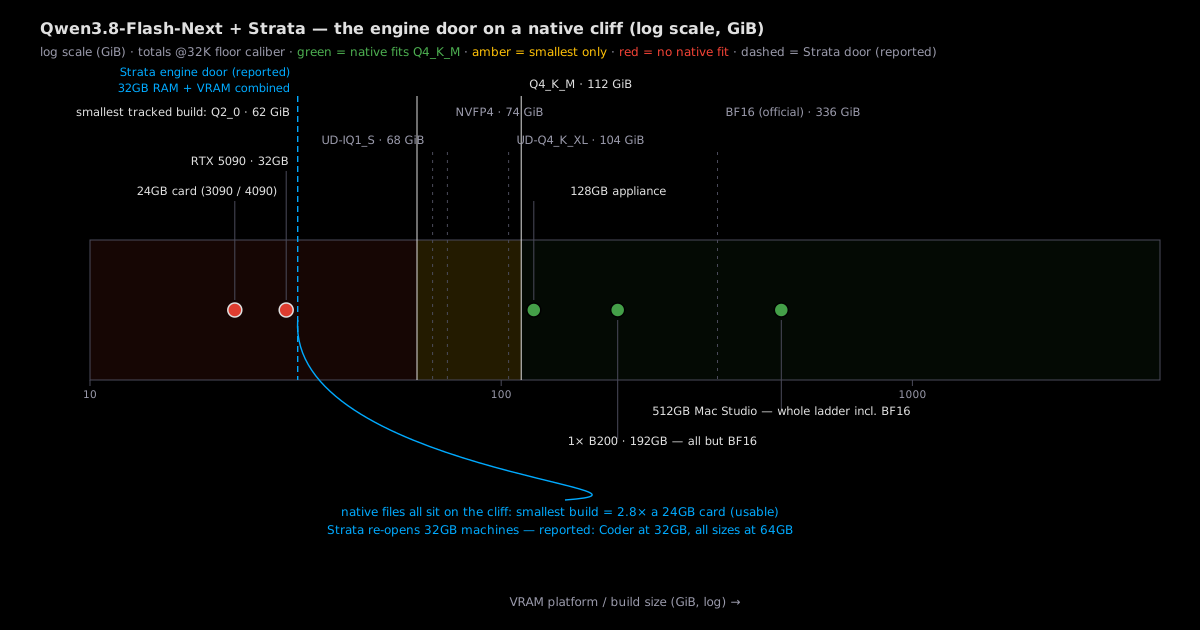
Rent it: minimal cloud configs (the raw files, unchanged)
| Quantization | Total VRAM | Minimal single-node config | Verdict |
|---|---|---|---|
| GSQ-RCO Q2_0 (measured) | 62.4 GiB | 1× B200 / 1× MI300X | smallest raw build · standard precision · n-gram table inside the file |
| UD-IQ1_S (measured) | 68.1 GiB | 1× B200 / 1× MI300X | smallest dynamic-IM raw build · unsloth |
| NVFP4 (nvidia, measured) | 74.0 GiB | 1× B200 / 1× MI300X | datacenter-native Blackwell format · not a consumer door |
| UD-Q4_K_XL (measured) | 104.2 GiB | 1× B200 / 1× MI300X | the Q4 door, raw files · fits the 128GB appliance with room |
| Q4_K_M (measured) | 111.9 GiB | 1× B200 / 1× MI300X | the standard-precision sweet spot · top of the 128GB fit |
| BF16 (official Qwen release) | 335.8 GiB | 2× B200 / 2× MI300X | the official raw build · 131 shards · 2× B200 |
These rows price the raw weight files — the same measured totals as the base page, from the same pinned file-sum chains (linked below). Card counts are plain division against published per-GPU memory; KV stays out of totals (config-derived, provisional — under a GiB at 32K against these weights). If your PC clears the engine's 32GB-combined door, this table is not your path — the FAQ tiers are.
Appliance / unified-memory form factors
| Appliance | Unified memory | Best fit | Verdict |
|---|---|---|---|
| Mac Studio M3 Ultra | 512 GB | every raw build fits, official BF16 included (335.8 GiB) — usable is 7.75× the smallest file; Q5-class, Q8_0, and the official release all load with headroom | FITS · every raw build, incl. official BF16 |
| Mac Studio M4 Max | 128 GB | standard raw builds Q2_0 (62.4 GiB) through Q4_K_M (111.9 GiB) fit — usable is 1.94× the smallest file, with 8-plus GiB of spare at Q4_K_M; Q5-class and up do not fit | FITS · Q2_0–Q4_K_M, standard precision |
| NVIDIA DGX Spark | 128 GB | same class as the M4 Max row — standard raw builds Q2_0 through Q4_K_M fit; Q5-class and up do not fit | FITS · Q2_0–Q4_K_M, standard precision |
| A home PC + the Strata engine | 32 GB combined | the engine's stated door — at least 32 GB of RAM and VRAM together with a single 12GB+ card; tiers, rigs, and the first-launch RAM load are in the FAQ (reported) | REPORTED · engine door, not a file fit |
Read the first three rows as the raw-file answer — they are the base page's math on the base page's measured files. The 128GB boxes fit standard builds Q2_0 through Q4_K_M with real headroom; the 512GB M3 Ultra fits everything measured including official BF16 (335.8 GiB). The fourth row is the one this page exists for: a home PC with at least 32 GB of RAM and VRAM together and a 12GB+ card, per the README's stated door (reported, tier table in the FAQ). Ratios on the appliance rows compare usable memory to the build's measured weights file size (61.9 GiB for the smallest, before the overhead anchor — not the 62.4 GiB total), both in GiB; the engine row's 'fit' is the engine's own claim, not a file-size comparison — which is exactly why it carries a reported badge instead of a measured one.
Can't run it? The distill / step-down ladder
The step-down question inverts on this page. If a 32GB-combined PC plus the engine is not your path, the smaller same-family body is Qwen3.8-27B — the 24GB-class champion. If you want these exact weights without the engine, the raw-file doors in the tables above — 128GB appliance, one B200, 512GB Mac Studio — are the way down from the cliff, and the base page carries the full cliff economics, the 125B / 175B caliber note, and the supply picture.
Lineage, stated plainly: Strata wraps Qwen3.8-Flash-Next — engine × base model, two dimensions, one page each. The base page prices the raw files and links here; this page prices the engine arrangement and links back. The README already lists an additional supported model (Qwen3.6-35B-A3B, plus a manually-installed uncensored IQ3_XXS variant); each new base a wrapper adopts is a new page plus a lineage edge like this one, not a paragraph added here.
Private deployment (enterprises, labs, providers)
For teams, Strata is a private-deployment story before it is a consumer one. The engine serves an OpenAI-compatible API on localhost (127.0.0.1:8080/v1), an Anthropic-style /v1/messages endpoint, a Responses API, and an MCP server (README-pinned below), so existing clients can point at a desktop tower instead of a cloud region. Privacy, in the engine's own words: 'Your chats and files stay on your PC' — with one stated exception: the chat's web-search feature sends the search words to DuckDuckGo; search is the one feature that ships something off the machine. License split to respect: the engine is MIT; the weights it downloads remain Qwen Community License 1.0 builds, credited by the README to ISTA-DASLab, UkisAI (Swift 1.5), agentionai (Gyro), and Unsloth. Honesty items, both reported: the project is young — v0.2.0-beta at the October 2026 README, with hundreds of open issues on the October 2026 GitHub snapshot (GitHub's count includes PRs and the count swings daily under active triage — read it as 'very actively triaged', not a stable figure) — and every performance and memory figure on this page is the engine's own claim, linked and labeled reported, not independently measured.
Or just use the API
Honest take: the API is the exit that makes the whole self-host question optional. A 125.0 B-body / 6.0 B-active MoE is the cheapest shape for hosted providers to serve; the Qwen3.8-family search is linked below, and our October 18, 2026 OpenRouter snapshot enumerates the qwen3.8 siblings but no flash-next listing — check the provider's live model list before committing. If the reason you are here is privacy, the engine's localhost API plus its stated privacy model is the middle ground; if the reason is cost, the API almost certainly wins. Prices are linked, not pinned.
Where every number comes from (every figure carries its tag)
| Tag | Slot | What it is | What the verdict can claim |
|---|---|---|---|
| measured | Base-model weights | Strata ships no weights of its own — the engine downloads builds from the publishers its README credits (ISTA-DASLab, UkisAI, agentionai, Unsloth). The file sums priced on this page are the base model's: official 131-shard BF16 plus community GGUF ladders, sizes summed at pinned revisions, whole-model sums with the n-gram table inside the files (vision mmproj and MTP sidecars excluded, per the collection notes). The door-setting builds are pinned below; the full ladder lives in this site's supply database. | Determinate at each door — a platform above or below a measured file size is a fact, not an estimate. |
| reported | Engine door, tiers, speeds | Every engine figure on this page — the 32GB-combined door with a 12GB+ card, the tier table (Gyro-S / Coder at 32GB up to UD-IQ4_XS–Q8_0 at 96GB+), the rig numbers (94 tok/s decode for Q2_0 on a 5070 12GB with 64GB RAM, and the rest), speculative decoding at 1.6-1.8×, the 35–55 GB first-launch RAM load — is quoted from the pinned README (2026-10-20 recapture, line numbers in our collection notes), labeled reported, and not re-measured by us. | A real door on the engine's own word: read its rows as 'the engine states', not 'we verified'. |
| reported | Engine identity + reception | GitHub snapshot of October 2026 — Niko1221/Strata, created September 24, 2026, MIT, C++, ≈28K stars and ≈3K forks, open issues in the hundreds (GitHub's count includes PRs and the count swings daily under active triage — read it as 'very actively triaged', not a stable figure), v0.2.0-beta — plus the Hacker News front-page thread of October 4, 2026 (900+ points at capture). Both linked below. | Identity and reception claims track the linked pages. |
| reported | Privacy model | 'Your chats and files stay on your PC' and the DuckDuckGo search-words exception are the README's own sentences (pinned section below). The local API endpoints are README-documented. Whether a given build does anything beyond that is worth a look at the repo before you bet a compliance program on it — this page makes no telemetry claims. | Privacy claims track the README's wording, quoted verbatim. |
| provisional | Totals (weights + overhead) + cloud card counts | Same as the base page: measured weights + a measured overhead anchor (llama.cpp discussion #9936); KV out of totals (config-derived, 24,576 B/token for the 12 full-attention layers — under a GiB at 32K). Card counts are plain division against published per-GPU memory (192GB B200, MI300X class). | The overhead line is a rounding-level term next to these weights; card counts follow arithmetically once totals are set. |
FAQ
What is Strata?
An open-source engine (GitHub Niko1221/Strata; MIT; C++; created September 24, 2026) that runs Qwen3.8-Flash-Next on ordinary PCs. The README's own line: 'Strata runs Qwen3.8-Flash-Next, a 125-billion-parameter model that normally needs a server, on a normal PC' — where '125B' is the language body; the total parameter count is ~175B once the 51.2B n-gram embedding table is counted, the same caliber wording as the base page (body ~125B, total ~175B including the 51.2B n-gram embedding table). The engine's model of the model is a 'team of 24,576 small specialists' — 512 experts × 48 layers, which reconciles with the official config — of which 10 per layer need to be resident, letting the rest tier across VRAM, RAM, and SSD, with a 29 GB n-gram lookup table (≈27 GiB) read from disk. Version at the October 20, 2026 README: 0.2.0-beta. Reception: front page of Hacker News on October 4, 2026 (900+ points at capture, linked below); ≈28K stars as of October 2026. Lineage, stated once: Strata wraps Qwen3.8-Flash-Next — engine × base, two dimensions, one page each. Every figure in this answer is the engine's or GitHub's own claim, reported and linked; this site measures files, not engines.
Does Strata only run Qwen3.8-Flash-Next?
No — the engine already lists a second model, the technique is architecture-general, but support arrives per architecture, not automatically. The facts, from the pinned README (reported): its model menu pairs Qwen3.8-Flash-Next with Qwen3.6-35B-A3B — 'a smaller, different model that reads pictures and can answer several requests at once' — both sparse-MoE designs. The theory: what the engine streams is experts — only the hot few of each layer's hundreds need to be resident while the rest tier across VRAM, RAM, and SSD — which is a property of sparse-MoE architecture, not of one model; any large sparse-MoE release is a candidate, while dense models have no experts to stream and do not get a door like this. The reasonable inference: successor MoE models are the likely next additions — but each architecture needs engine-side support, and that part is documented rather than inferred: the QWEN36 doc states the second model runs on 'its own engine path (`src/qwen35`; `strata` switches to it from the file's architecture)' — so day-1 support for a brand-new architecture is not the thing to assume; check the README's current model list before buying hardware for a future model. All of the above is the engine's own claim, reported and linked; this site measures files — and when a second model's files matter here, they get their own measured page, linked from this one.
Can my 32GB PC run Strata?
Per the README's stated door (pinned): at least 32 GB of RAM and graphics memory together, on a single card with 12GB or more — RTX 20/30/40/50 class, AMD RX 6800 or newer, Intel Arc, Apple Silicon (M1+, macOS 15+), or Strix Halo — plus about 80 GB of free disk (≈74.5 GiB). First launch loads 35–55 GB into RAM. Then the tier table, in the README's own GB figures: 32GB combined → Gyro-S or Coder; 40GB → Swift 1.5 IQ2_XS or Gyro-M; 48GB → IQ3_XXS; 64GB → IQ3_S; 96GB and up → UD-IQ4_XS through Q8_0. What the tiers mean: Gyro-S and Coder are the small-memory specialists (Coder keeps half the experts and is weaker outside code); the IQ2_XS → IQ3_S ladder trades quality for memory; 96GB+ is where the standard quants begin. Weights come from the engine's credited publishers — ISTA-DASLab, UkisAI, agentionai, and Unsloth builds. All of the above is reported, not measured by us — and a beta engine's tier table is a moving target, so re-check the pinned README before buying hardware.
What do I download for Strata?
Three install paths per the README: a desktop app (.exe / .AppImage / .dmg), a terminal one-liner (curl or PowerShell, scripts on the repo), or an AI-assisted install; building from source is documented too (START-HERE.bat / setup.sh). The engine fetches its weight builds itself from the credited publishers. Practical notes from the same README: keep the n-gram table on an SSD — a 29 GB lookup file; image input falls back to CPU when VRAM is under 24GB (one rig logged 57 ms versus 3.1 s for a 260-token image); and version 0.2.0-beta is young software, with hundreds of open issues on the October 2026 GitHub snapshot (GitHub's count includes PRs and the count swings daily under active triage — read it as 'very actively triaged', not a stable figure) — expect the moving parts of a beta.
How fast is Strata on an RTX 5070?
The README's own rig table — reported, with the rigs pinned by line in our collection notes: on an RTX 5070 12GB with 64GB of system RAM, Q2_0 decodes at 94 tok/s with 2,650 tok/s prefill; IQ2_XS 79/2,090; IQ3_XXS 62/1,750; IQ3_S 53/1,620; Coder 55/2,180. An RX 9070 XT 16GB rig logs Q2_0 at 60/1,160. For the RTX 3090 the README's words are 'should write about 100-140 tokens per second' — a prediction, quoted as written, not a measurement. Speculative decoding claims 1.6-1.8× ('the same answer, sooner'), and long-document prefill is chunked at 8,192 tokens at over 1,000 tok/s. Two honesty notes: these are engine-published figures on engine-chosen rigs, so treat them as the top of a plausible range rather than a guarantee; and a 12GB card sharing residency with system RAM will not match datacenter throughput — it matches your desk, which is the point.
Is my data private with Strata?
In the README's own sentence: 'Your chats and files stay on your PC.' One stated exception, same section: the chat's web-search feature sends the search words to DuckDuckGo — search is the one feature that ships something off the machine. Everything else — chats, files, the local API — stays local by architecture rather than by policy promise: the engine serves localhost endpoints (OpenAI-compatible at 127.0.0.1:8080/v1, an Anthropic-style /v1/messages, a Responses API, and an MCP server), so the serving path needs no third party. Whether a given build does anything beyond what the README states is a question to take to the repo — this page makes no telemetry claims.
Strata vs running the raw GGUF in llama.cpp — what's the difference?
The file is the same; the residency is not. The raw Q2_0 build totals 62.4 GiB (2× a 24GB card), and a llama.cpp-class runtime loads it whole into addressable memory — so the hardware doors are the ones in the tables above: 128GB appliance, one B200, 512GB Mac Studio. Strata's change is where the bytes live: only 10 of each layer's 512 experts are resident at a time, the rest tier across VRAM, RAM, and SSD, and the 29 GB n-gram table reads from disk — which is how a file with no consumer door gets a stated 32GB-combined one. The costs, honestly: the low tiers are low-bit quants (a quality trade-off against the Q4-and-up builds priced on the base page); the Coder build keeps half the experts and is weaker outside code; disk-resident experts are slower than VRAM-resident ones; and every number in this answer is the engine's claim, reported and linked. The raw-file route remains the quality ceiling — Strata is how you reach it from a desk, not a replacement for it.
What about the Coder, Swift, and Gyro variants?
Four names, four different things (README tier table, reported). Coder: keeps half of the experts — the 32GB-friendly specialist, code-strong and 'weaker outside code' by the README's own words. Swift 1.5: UkisAI's low-thinking finetune, offered at IQ2_XS for 40GB-class machines. Gyro-S and Gyro-M: agentionai builds — Gyro-S needs 27.6 GB (≈25.7 GiB) of memory (58.5 GB ≈ 54.5 GiB download), Gyro-M 35 GB (≈32.6 GiB), at about IQ3_XXS quality and 17-21% slower than Q2_0; NVIDIA/AMD only, no Intel or Mac build. Two more from the same table: an NVFP4 tier that needs about 80GB of RAM, and an OrcaRouter Uncensored IQ3_XXS variant that installs manually. The plain quants (IQ2_XS, IQ3_XXS, IQ3_S, UD-IQ4_XS up to Q8_0) are the standard ladders from the credited publishers — the tiers just map them to memory sizes.