Ornith-1.5-9B VRAM requirements
a 12GB card (10.5 usable) runs it, 3.6 GiB to spare · the native 256K window needs 13.9 GiB
Ornith-1.5-9B needs 6.9 GiB at Q4_K_M, 32K context — a 12GB card (10.5 usable) runs it with 3.6 GiB to spare, and at 8K the same build is 6.2 GiB. The hybrid attention is why the bill is small: only 8 of its 32 layers are full attention, so the cache grows at 32,768 bytes per token (1.0 GiB at 32K) while 24 GatedDeltaNet layers hold a fixed fp32 state. Q4_K_M is the community default; the official Q8_0 build (10.7 GiB) is the 16GB door, and BF16 (18.2 GiB at bartowski, 18.7 GiB official) fits a 24GB card (22.5 usable) with 3.8 GiB to spare. At the native 256K window the same Q4_K_M config is 13.9 GiB.
Prepared by LLM VRAM · build · weights measured at pinned revisions, context and overhead explicit · sources below
Ornith-1.5-9B-Q4_K_M.gguf from ornith-ai's official GGUF repo (pinned, 5.38 GiB) and load it in llama.cpp or LM Studio — a 12GB card holds the full 32K context with 3.6 GiB to spare, and even the native 256K window fits a 24GB card comfortably (13.9 GiB). For image input add the mmproj pack (0.86 GiB BF16) from the same repo.Ornith-1.5-9B is a 9.65B-parameter hybrid from Ornith-ai (BF16 safetensors file-derived), released 2026-08-18 under MIT (declared in the model card's front matter and the repository's license tag — the pinned repository contains no LICENSE file): 32 layers, of which 8 are full-attention GQA — 4 KV heads, head dim 256 (config.json) — and 24 are GatedDeltaNet linear-attention layers with a fixed fp32 recurrent state. Native context is 262,144 tokens. Because only a quarter of the layers pay a growing cache, the 32K KV bill is 1.0 GiB where a plain 32-layer GQA model of this size would pay roughly four times more — which is why the buying question collapses to "a 12GB card (10.5 usable)", and why the native 256K window, not the weights, is what pushes you to 16GB or 24GB.
Page built · each pinned source carries its own access date in Where every number comes from
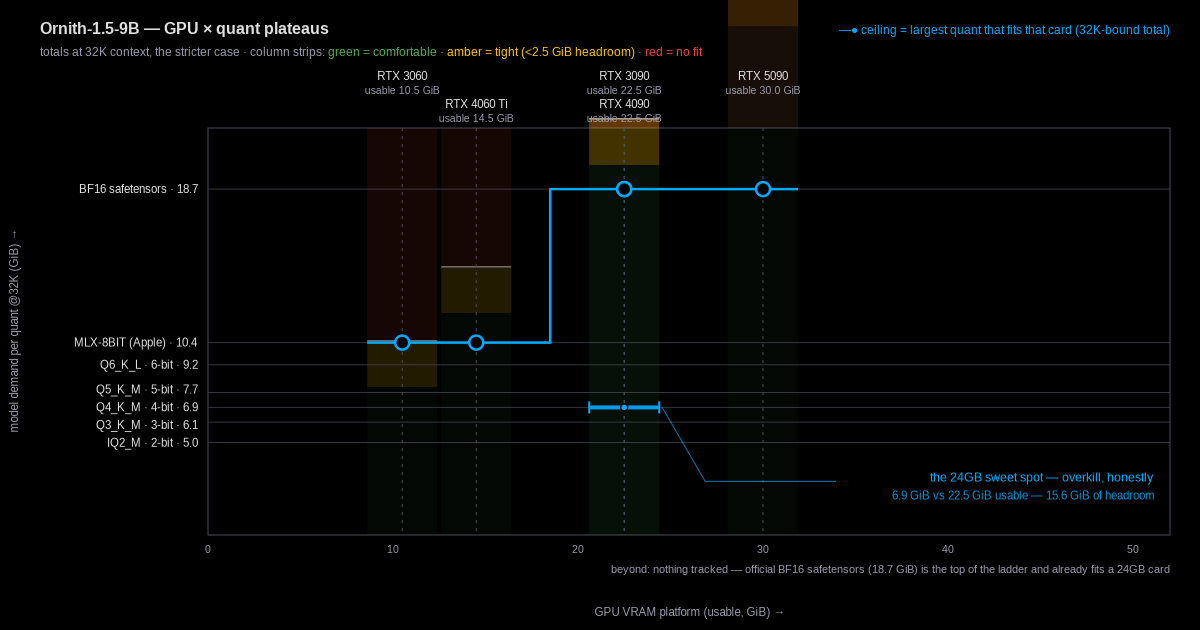
How much VRAM at each quantization? (weights + overhead + 4K KV, batch 1)
| Quantization | VRAM needed @4K | Total @32K | KV @32K provisional i · beyond the @4K column | Smallest tracked fit (context noted) | Note |
|---|---|---|---|---|---|
| IQ2_M | 4.2 GiB | 5.0 GiB | 1.0469 GiB | RTX 3060 12GB | measured weights · at 32K incl. KV: 5.0 GiB |
| Q3_K_M | 5.2 GiB | 6.1 GiB | 1.0469 GiB | RTX 3060 12GB | measured weights · at 32K incl. KV: 6.1 GiB |
| Q4_K_M | 6.1 GiB | 6.9 GiB | 1.0469 GiB | RTX 3060 12GB | measured weights · at 32K incl. KV: 6.9 GiB |
| Q5_K_M | 6.9 GiB | 7.7 GiB | 1.0469 GiB | RTX 3060 12GB | measured weights · at 32K incl. KV: 7.7 GiB |
| Q6_K_L | 8.3 GiB | 9.2 GiB | 1.0469 GiB | RTX 3060 12GB | measured weights · at 32K incl. KV: 9.2 GiB |
| MLX_8BIT | 9.5 GiB | 10.4 GiB | 1.0469 GiB | RTX 3060 12GB | measured weights · at 32K incl. KV: 10.4 GiB |
| Q8_0 | 9.8 GiB | 10.7 GiB | 1.0469 GiB | RTX 3060 12GB · ≤~27K ctx | measured weights · at 32K incl. KV: 10.7 GiB |
| BF16_ORNITH_AI | 17.8 GiB | 18.7 GiB | 1.0469 GiB | RTX 3090 24GB | measured weights · at 32K incl. KV: 18.7 GiB |
GB vs GiB: card names are the manufacturer's nominal GB; totals here are GiB (230 bytes) — a "12GB" card holds 12 GiB. The official Q4_K_M file is 5,780,090,816 B = 5.78 GB (decimal download size) = 5.4 GiB. Caliber →
The 48GB-class doors, spelled out: a dual-GPU combo (2× 24GB; not one card doubled), a workstation card (RTX 6000 Ada), or a Mac Studio (unified memory; runs, slower tok/s). For this model they are all absurd — the entire tracked ladder, both BF16 builds included, fits one 24GB card.
How this page computes the numbers (reproduce any cell)
- usable VRAM = nominal minus reserve, per card: 12GB → 10.5 GiB, 16GB → 14.5 GiB, 24GB → 22.5 GiB, 32GB → 30.0 GiB.
- total@32K = listed file size + provisional runtime allowance + KV@32K; KV@32K = 1.0469 GiB (config-derived stacked upper bound — 34,305 B/token effective at 32K; actual ≤ value, composition in sources)
- total@4K (main column) = total@32K − (KV@32K − 0.046875) × 7/8 — the constant state (0.046875 GiB on this hybrid) is not scaled down at shorter context; only the linear part divides by eight.
- The "≤~XK ctx" note = 8K + 32K × (usable − total@8K) ÷ KV@32K — the context length that exactly fills the card (KV grows linearly with context on this model).
- A build fits a card at 32K when total@32K ≤ usable; tight = under 2.5 GiB of headroom, one site-wide threshold.
Is your GPU enough? (find your card: one row tells you)
| Your GPU | VRAM | Biggest quant that fits (ceiling) | How it feels |
|---|---|---|---|
| RTX 3060 12GB | 12 GB | MLX_8BIT (8-bit) · 10.4 GiB | 0.10 GiB spare at 32K (incl KV bound) |
| RTX 4060 Ti 16GB | 16 GB | Q8_0 (8-bit) · 10.7 GiB | 3.8 GiB spare at 32K (incl KV bound) |
| RTX 3090 24GB | 24 GB | BF16_ORNITH_AI (16-bit) · 18.7 GiB | 3.8 GiB spare at 32K (incl KV bound) |
| RTX 4090 24GB | 24 GB | BF16_ORNITH_AI (16-bit) · 18.7 GiB | 3.8 GiB spare at 32K (incl KV bound) |
| RTX 5090 32GB | 32 GB | BF16_ORNITH_AI (16-bit) · 18.7 GiB | 11.3 GiB spare at 32K (incl KV bound) |
Quants stack by size: each GPU has exactly one ceiling — a card that runs a bigger build runs every smaller one. Main-column totals price the 4K load (weights + overhead + the KV term at 4K — the community runtime default); each row's Note prices the full 32K load this page promises (Q4_K_M at 32K = 6.9 GiB), and CPU offload trades tok/s for headroom.
What GPU should you buy for it? (the 12GB sweet spot logic)
| The logic | 12GB is the cheapest tier that runs the promised 32K config: Q4_K_M totals 6.9 GiB against 10.5 GiB usable, 3.6 GiB to spare. Above it, 16GB buys the official Q8_0 build with 3.8 GiB spare; 24GB buys nothing for this model alone — even the official BF16 build (18.7 GiB) leaves 3.8 GiB there. Buying up is buying for the 27B-class pages in the related tables. |
| Why it fits | At Q4_K_M the weights are 5.4 GiB, and the hybrid KV bill at 32K adds only 1.0 GiB because 24 of the 32 layers never grow a cache. Even at the native 256K window the same build is 13.9 GiB — a 16GB card tight, a 24GB card comfortable. |
⚠ Tight is a site-wide threshold: under 2.5 GiB of headroom. Q4_K_M @32K leaves 15.6 GiB on a 24GB card — beyond comfortable. The tight rows worth knowing are both 12GB ceilings: the MLX-8bit build (10.4 GiB, 0.1 spare) and Q6_K_L (9.2 GiB, 1.3 spare) — neither is the page's pick.
Tracked builds (actual file sizes, not theory)
| Build | Publisher | File size | 24GB @32K | Source |
|---|---|---|---|---|
| IQ2_M | bartowski | 3.5 GiB | OK ON 12G · 5.0 | HF @1fc60d68 verified |
| Q3_K_M | bartowski | 4.6 GiB | OK ON 12G · 6.1 | HF @1fc60d68 verified |
| Q4_K_M | ornith-ai | 5.4 GiB | OK ON 12G · 6.9 | HF @abdd624b verified |
| Q5_K_M | ornith-ai | 6.2 GiB | OK ON 12G · 7.7 | HF @abdd624b verified |
| Q6_K_L | bartowski | 7.6 GiB | OK · 9.2 | HF @1fc60d68 verified |
| MLX_8BIT | ornith-ai | 8.9 GiB | OK · 10.4 | HF @b4b70543 verified |
| Q8_0 | ornith-ai | 9.1 GiB | OK · 10.7 | HF @abdd624b verified |
| BF16 | ornith-ai | 18.0 GiB | OK · 19.5 | HF @489cb979 verified |
| BF16_ORNITH_AI | ornith-ai | 17.1 GiB | OK · 18.7 | HF @abdd624b verified |
Same quant name, different builds: Q4_K_M through Q6_K exist in ornith-ai's official repo and in bartowski's 24-quant ladder as separate builds — different publishers, repos and file bytes — and the table cites the official file as a display choice; the bartowski builds stay in the candidate universe. BF16 is three independent builds — bartowski's GGUF conversion (16.7 GiB), the official GGUF conversion (17.1 GiB) and the official safetensors (18.0 GiB) — of which the table shows the official builds. Where 12GB ends at 32K: the MLX-8bit build at 10.4 GiB (Apple format) or Q6_K_L at 9.2 GiB on CUDA; the official Q8_0 is 0.2 GiB too big.
Self-host or API?
Estimate owned-GPU vs API breakeven
This is a token-cost sensitivity exercise, not a purchase recommendation. The model still has to meet your quality and throughput needs.
Worked example: a $1,200 GPU kept 30 months plus 350W for 4 hours/day at $0.15/kWh costs about $46 per month. At a blended API price of $0.50/1M, breakeven is about 93M tokens/month. Replace every input with your own numbers.
| Input | Value |
|---|---|
Monthly cost $46 · Breakeven tokens/month 93M
The static defaults and the script use the same formula. Nothing leaves this page.
Formula and evidence
| Monthly hardware cost | GPU price ÷ months you keep it |
| Monthly electricity | average watts × hours/day × 30 ÷ 1000 × your kWh price |
| Breakeven usage | (hardware + electricity) ÷ blended API price per 1M tokens |
No OpenRouter listing was found in the 2026-10-31 models API. The $0.50 blended input is an editable example, not a provider quote. The $1,200 GPU input is an editable example, not a market quote. Check the live provider page before committing budget. OpenRouter model search
Where every number comes from (every figure carries its tag)
Totals: measured weights + the hybrid KV bill (8 full-attention layers grow with context, 24 GatedDeltaNet layers hold a fixed state — config-derived and labeled) + borrowed provisional overhead allowance. This page exists for one config: the 9.65B hybrid tier × Q4_K-class quant × 32K context — the rung where the answer stops being "which GPU" and becomes "the 12GB card you already own".
| Tag | Slot | What it is | What the verdict can claim |
|---|---|---|---|
| reported | model | Hugging Face config.json @489cb979 (identity carrier: 32 layers = 8 full-attention + 24 GatedDeltaNet, 4 KV heads, head dim 256, 262,144 max positions — the source of every architecture and KV figure on this page) | Tight, conditional — stands on the linked source, re-checkable by you. |
| reported | static | Hugging Face model page (ornith-ai/Ornith-1.5-9B, pinned README: publisher benchmark table and vLLM / SGLang / Transformers serving recipes) | Tight, conditional — stands on the linked source, re-checkable by you. |
| measured | static | Official GGUF tree @abdd624b (5 single-file quants, byte sizes read from the pinned listing: Q4_K_M 5,780,090,816 B · Q5_K_M 6,642,544,576 B · Q6_K 7,558,901,696 B · Q8_0 9,786,060,384 B · BF16 18,407,321,184 B; the mmproj vision projector, 921,704,672 B, is excluded from model weights) | Pinned fact — the file measurement is checkable; runtime is not measured. |
| measured | static | bartowski GGUF tree @1fc60d68 (24 single-file quants, the community ladder: IQ2_M 3,769,426,816 B · Q3_K_M 4,920,189,824 B · Q4_K_M 5,910,782,848 B · Q6_K_L 8,192,926,592 B · Q8_0 9,545,982,848 B · BF16 17,920,696,928 B) | Pinned fact — the file measurement is checkable; runtime is not measured. |
| measured | static | Official safetensors tree @489cb979 (4 shards, 19,306,303,864 B = 18.0 GiB BF16 — the source of the parameter count). BF16 exists as three independent builds — this safetensors file set, the official GGUF conversion (18,407,321,184 B = 17.1 GiB, ornith-ai GGUF repo @abdd624b) and bartowski's GGUF conversion (17,920,696,928 B = 16.7 GiB, bartowski repo @1fc60d68) — different repos and file sets, never merged by any percentage threshold; the BF16 rows on this page show the official builds as a display choice, and all three stay in the candidate universe | Pinned fact — the file measurement is checkable; runtime is not measured. |
| provisional | kv | KV cache @32K — 1.0469 GiB, config-derived: 8 full-attention layers × 4 KV heads × 256 dim × K/V × 2 bytes = 32,768 B/token × 32,768 tokens = 1.00 GiB, plus a fixed fp32 recurrent state of 0.046875 GiB for the 24 GatedDeltaNet layers (24 × 32 × 128 × 128 × 4 B). No published measurement; actual ≤ value | Very likely right, order of magnitude only — replaced the moment measured values land. |
| provisional | overhead | Deployment overhead — borrowed allowance from a Gemma 2 9B / 4K / FA-off log (507 MiB; provisional, not measured on this model) | Very likely right, order of magnitude only — replaced the moment measured values land. |
FAQ
Does Ornith-1.5-9B fit in 12GB VRAM?
Yes, with room. At the page's full 32K context the Q4_K_M build totals 6.9 GiB (5.4 GiB weights + 0.5 GiB overhead + a 1.0 GiB hybrid KV bill), leaving 3.6 GiB free on a 12GB card. The official Q8_0 build (10.7 GiB at 32K) misses a 12GB card by 0.2 GiB, so Q4 through Q6 is the practical 12GB band — Q5_K_M at 7.7 GiB is the largest comfortable one, and Q6_K_L at 9.2 GiB still fits but is tight (1.3 GiB spare). At 4K context the same Q4_K_M config is about 6.1 GiB.
How much VRAM does Ornith-1.5-9B need at Q4_K_M?
6.9 GiB at 32K context: 5.4 GiB weights (official GGUF file at a pinned revision), 0.5 GiB runtime overhead, 1.0 GiB KV cache. The KV bill is small because the model is hybrid: only 8 of its 32 layers are full attention, growing at 32,768 bytes per token, so 32K tokens cost 1.0 GiB, while the other 24 layers are GatedDeltaNet linear attention with a fixed fp32 state (0.05 GiB) that does not grow with context. At 8K context the same build is 6.2 GiB.
Can Ornith-1.5-9B run its full 256K context on consumer hardware?
On a 24GB card, comfortably; on 16GB, tight. At the native 262,144-token window the attention cache grows to 8.0 GiB, so the Q4_K_M config totals 13.9 GiB — 8.6 GiB of headroom on a 24GB card, 0.6 GiB on a 16GB card. A 12GB card still reaches about 146K tokens at Q4_K_M (4.6 GiB left for cache after weights and overhead), which is far beyond what most llama.cpp setups actually load. This page prices 32K because that is the config most people run; the longer window is a hardware step, not a different model.
Which Ornith-1.5-9B file should I download?
The official Q4_K_M GGUF from ornith-ai's repo — 5,780,090,816 B (5.78 GB, 5.4 GiB) — is the cleanest default, and bartowski's 24-quant ladder gives you the odd sizes (IQ2_M up to Q6_K_L) the official repo skips. Same-name files in the two repos are different builds (different publishers, repos and bytes), and this page cites the official file as the display choice. BF16 is three independent builds in the universe — bartowski's GGUF conversion (16.7 GiB), the official GGUF conversion (17.1 GiB) and the official safetensors (18.0 GiB) — the table shows the official builds, and bartowski's stays in the candidate universe. For image input add the mmproj projector (0.86 GiB BF16) from either repo.
Can Ornith-1.5-9B run on a Mac, and does the 12GB ceiling change?
Yes — ornith-ai ships MLX 4-bit (6.2 GiB at 32K) and MLX 8-bit (10.4 GiB at 32K) conversions, and on Apple silicon the MLX-8bit build is the 12GB-unified-memory ceiling, tight at 0.1 GiB spare. That row is Apple-only: on a CUDA 12GB card the largest build that fits is Q6_K_L at 9.2 GiB (1.3 GiB spare, tight), because the official Q8_0 misses by 0.2 GiB. The GPU ladder on this page lists the ceiling as the machine ceiling, not a recommendation.
How does this site compute these VRAM numbers?
Weights are measured file sizes at pinned revisions (sources below); totals add runtime overhead plus the KV cache at 32K context. Here KV@32K = 1.0469 GiB = 32,768 B/token × 32,768 tokens (8 full-attention layers × 4 KV heads × 256 dim, config-derived bound) + 0.05 GiB fixed state for the 24 linear layers. A build fits a card at 32K when the total clears usable VRAM (nominal minus reserve), and tight means under 2.5 GiB of headroom — the full formula lives in the method box under the quantization table.