Ornith-1.5-122B VRAM requirements
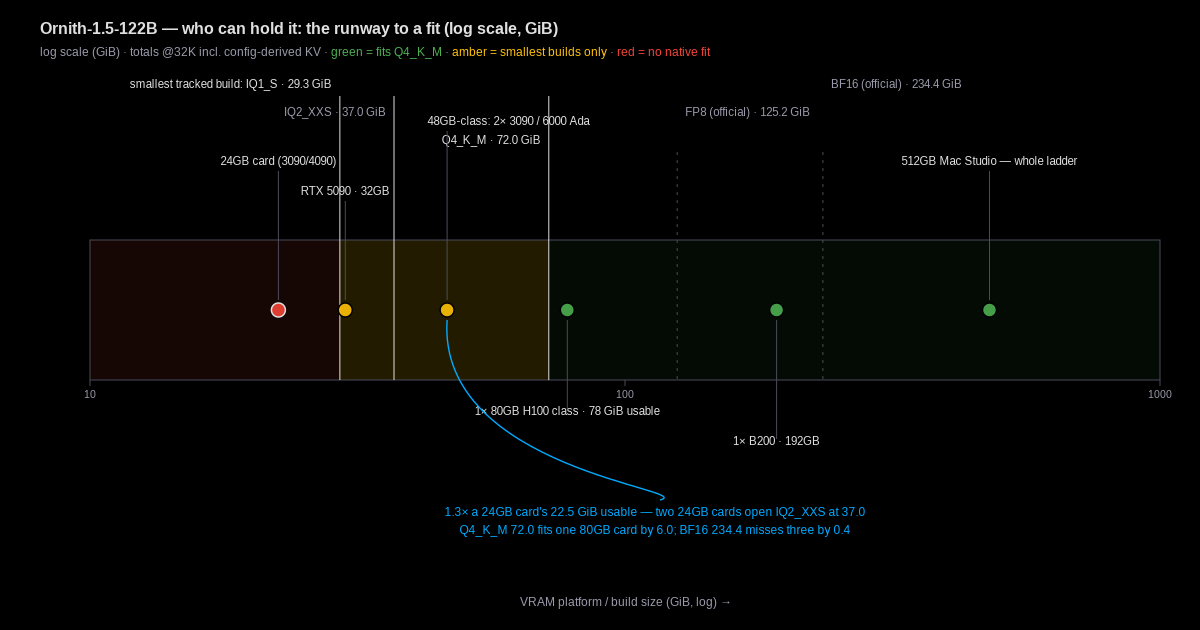
The smallest measured build is 29.3 GiB — bartowski's IQ1_S, 27.95 GiB of weights plus a config-derived hybrid KV cache of 0.89 GiB at 32K plus a borrowed overhead anchor (measured on a different configuration — a planning allowance here) — and the whole supply sits between it and the official BF16 release at 234.4 GiB. Comfort arrives by adding cards, not bits: two 24GB cards (45.0 GiB usable: 2×24 minus 1.5 each) hold IQ2_XXS at 37.0 GiB with about 8.0 GiB to spare. This tier appeared without an announcement — the family blog of August 2026 names the 397B, 35B-A3B and 9B tiers, and the 122B repository was created on 2026-10-16. Supply at the October 27, 2026 sweep: 40 measured builds across three publishing orgs (the official release, bartowski's 26-step ladder, unsloth's 10 dynamic builds), plus official FP8, NVFP4 and MLX conversions. The smaller same-family bodies are Ornith-1.5-35B-A3B and Ornith-1.5-9B.
Prepared by LLM VRAM · build · weights measured at pinned revisions, context and overhead explicit · sources below
Updated · data status: MEASURED WEIGHTS — totals = measured weights + config-derived KV at 32K (0.8906 GiB) + borrowed overhead anchor; a KV row is in the source table, not a footnote; every weight a pinned file-size sum (the six door-setting builds, drawn from the official release, the official GGUF/FP8/NVFP4 trees and bartowski's ladder, are pinned below; the unsloth and MLX builds in the full ladder are summed at pinned revisions recorded in this site's supply database, not reproduced here)
Rent it: cloud capacity floors (the raw files, priced by the card)
| Quantization | 32K total T (floor rows: KV unsized) | Aggregate capacity floor | Verdict |
|---|---|---|---|
| IQ1_S (measured) | 29.3 GiB | 1× B200 / 1× MI300X | smallest build · bartowski · the 32GB door, tight |
| IQ2_XXS (measured) | 37.0 GiB | 1× B200 / 1× MI300X | the two-24GB-card door · about 8.0 GiB spare |
| Q4_K_M (measured) | 72.0 GiB | 1× B200 / 1× MI300X | the 80GB-card door · official ladder starts here |
| NVFP4 (official, measured) | 73.7 GiB | 1× B200 / 1× MI300X | Blackwell-native datacenter format · not a consumer door |
| FP8 (official, measured) | 125.2 GiB | 1× B200 / 1× MI300X | datacenter build · fits one B200 |
| BF16 (official release) | 234.4 GiB | 2× B200 / 2× MI300X | the official build · 2 B200s |
Card counts are plain division (rounded up) against published per-GPU memory (192GB B200, MI300X class) on measured totals. What is inside each total: measured weight file sizes, plus a config-derived KV cache at 32K (0.8906 GiB), plus a borrowed overhead anchor (measured on a different configuration — a planning allowance here) (llama.cpp discussion #9936). KV is already counted here — 12 full-attention layers × 2 KV heads × 256 dims × K/V × 2 bytes = 24,576 bytes per token, so 32K of context costs 0.75 GiB, and the 36 linear-attention layers hold a constant 0.14 GiB of fp32 state. The official GGUF ladder starts at Q4_K_M (72.0 GiB) and has no lower rung; everything below it comes from community ladders, and the smallest rung of all (IQ1_S) is bartowski's. One row is a different kind of build: the official NVFP4 (73.7 GiB) is a Blackwell-native datacenter format, sized for B200-class deployment rather than a consumer door.
Appliance / unified-memory form factors
| Appliance | Unified memory | Best fit | Verdict |
|---|---|---|---|
| Mac Studio M3 Ultra | 512 GB | every measured build fits, official BF16 included (234.4 GiB) — usable is 17.20× the smallest file; Q8_0, MLX-8bit and official FP8 all load with headroom | FITS · everything measured, incl. official BF16 |
| Mac Studio M4 Max | 128 GB | the ladder runs from IQ1_S (29.3 GiB) to UD-Q6_K_XL (107.8 GiB) — usable is 4.30× the smallest file, with about 12 GiB of spare at the top of the fit; Q8_0 (124.8), MLX-8bit (122.2) and official FP8 (125.2 GiB) do not fit | FITS · IQ1_S–UD-Q6_K_XL |
| NVIDIA DGX Spark | 128 GB | same class as the M4 Max row — IQ1_S through UD-Q6_K_XL fit; Q8_0, MLX-8bit and official FP8 do not | FITS · IQ1_S–UD-Q6_K_XL |
The 128GB answer is the narrow one here. The M4 Max (macOS) / DGX Spark (Linux/CUDA) class (120 GiB usable with the wired limit raised; 96 GiB at the macOS default) runs from IQ1_S all the way to UD-Q6_K_XL (107.8 GiB equivalent in whole-model terms), but it stops there: Q8_0, the official MLX-8bit and the official FP8 all land above the ≈120 GiB usable at the raised limit; 96 GiB default line. About 12 GiB of spare at the top of the ladder is real headroom, not a floor fit. The 512GB M3 Ultra (480 GiB usable at the raised limit; 384 GiB default, 17.20× the smallest file) runs every measured build including official BF16 (234.4 GiB) with room to spare. Ratios compare usable memory to the smallest build's measured weight file size (27.9 GiB before the KV and overhead terms — not the 29.3 GiB total), both in GiB (binary), the same single-unit division end to end; unified-memory bandwidth trails datacenter GPUs by an order of magnitude, so these are 'it runs' verdicts, not 'it runs fast'. DGX Spark runs NVIDIA DGX OS (Ubuntu-based) on 128GB unified memory; its GPU working-set budget is unverified here — the macOS raised/default figures do not apply to it.
Can't run it? The distill / step-down ladder
No official Ornith-1.5-122B distill is tracked in our sources at the October 27, 2026 sweep, and this family does not need a re-trained one to offer a step-down: it ships a ladder. Ornith-1.5-35B-A3B (35.95B total parameters, 3B active per token) is the next body down and has its own page; Ornith-1.5-9B is two tiers below and runs on 8–16GB cards. One documented-but-absent build: the model card points at an Ornith-1.5-122B-Mobile quantized variant for phones, and no repository answers under that name or under Ornith-1.5-Mobile in our probes of October 27, 2026 — the mobile claim is the publisher's, uncorroborated by files this site can sum. When official smaller siblings ship, each gets its own VRAM page and this section links the ladder.
Step-down options that exist: Ornith-1.5-35B-A3B — the same family's 3B-active MoE, priced for 24GB-class cards with a 32GB comfort door — and Ornith-1.5-9B, the small-card body of the same release. The also-cliff-class models are linked below.
Private deployment (enterprises, labs, providers)
A separate query family from everything above: reference configs for the hybrid stack, compliance and air-gapped installs, TCO modeling against an API line that has no Ornith listing. On the license, the boundary matters: the model card declares MIT in its front matter and the HF repository carries the license:mit tag, but the pinned tree (77 files, 78 entries including one directory) contains no LICENSE file and both the card's license link and the repository's LICENSE path return 404 in our probes of October 27, 2026 (this page is not legal advice — read the terms before you depend on them). Reference stack: vLLM ≥0.19.1 or SGLang ≥0.5.9, Transformers ≥5.8.1; the card's own serving line is a vLLM command with --gpu-memory-utilization 0.90. Capacity is not the problem: one B200 already covers every build through official FP8, and 2 B200s hold the BF16 release — the question is governance and throughput. Budget an integration week, not an afternoon: 256 experts per layer with 8 routed plus 1 shared active per token, 36 of the 48 layers are linear-attention, and the window extends to roughly a million tokens with a YaRN factor of 4.0.
Or just use the API
Honest take: this is the size class where hosted APIs are usually cheapest to run — a ~125.1 B-parameter mixture-of-experts whose smaller sibling already routes 3B-class activation (the publisher does not state this tier's active count) — and this model has no hosted listing to compare against. Our full-table OpenRouter snapshot of October 27, 2026 (462 models) contains no Ornith entry at all, so treat availability as provider-dependent and check the provider's live model list before you commit code. Self-hosting here is a residency decision, not a savings decision — except at long context: the window runs to roughly a million tokens, which is exactly where per-token API pricing stops being cheap.
Where every number comes from (every figure carries its tag)
| Tag | Slot | What it is | What the verdict can claim |
|---|---|---|---|
| measured | Build file sizes | Official 77-file BF16 tree, the official GGUF ladder, official FP8 and NVFP4 safetensors, official MLX 4-bit and 8-bit conversions, plus bartowski's 26-step and unsloth's 10-step GGUF ladders — sizes summed at pinned revisions. The six door-setting builds are pinned below; the full 40-build ladder lives in this site's supply database. | Determinate at each door — a platform above or below a measured file size is a fact, not an estimate. |
| reported | Model identity (256 experts, 8 routed + 1 shared, ~125B by file size) | The repository name says 122B; summing the official BF16 shards gives 233.0 GiB, which is 125.09B parameters at 2 bytes each. The config settles the shape: 256 experts per layer with 8 routed plus 1 shared active per token, 48 layers at a 4-layer full-attention interval, a 262,144-token window. No active-parameter count is published for this tier, and this page does not invent one. | Identity claims track the linked card and config; the parameter figure follows the file sum the rest of this page is built on. |
| provisional | Totals (weights + KV + overhead) | Simple addition: measured weights + a config-derived KV cache at 32K + a borrowed overhead anchor (measured on a different configuration — a planning allowance here) (llama.cpp discussion #9936). The KV term is 24,576 bytes per token — 12 full-attention layers × 2 KV heads × 256 dims × K/V × 2 bytes — costing 0.75 GiB at 32K, plus 0.1406 GiB of constant fp32 state across the 36 linear layers: 0.8906 GiB in total. | The KV and overhead terms together are 1.4 GiB. They move the 32GB door from 27.9 to 29.3 GiB but do not change which card class holds which build. |
| provisional | Cloud card counts | Simple division (rounded up) of whole-model totals by published per-GPU memory (192GB B200, MI300X class) — arithmetic on measured files, not a benchmark. A real deployment also carries runtime reserves and fragmentation, which is why the site keeps a 6.25% reserve on consumer cards. | Card counts are a planning floor; one class up is always the safe booking. |
FAQ
What is Ornith-1.5-122B?
The largest tier of ornith-ai's Ornith-1.5 release that a workstation can still hold, added quietly two months after the rest of the family: the family blog of August 2026 announces the 397B, 35B-A3B and 9B tiers, and this 122B repository was created on 2026-10-16 with no matching announcement. The pinned config describes a 256-expert mixture-of-experts: 48 layers with a full-attention layer every fourth one (12 full-attention, 36 linear-attention), 8 routed plus 1 shared expert active per token, a 262,144-token native window, and vision input. The card adds the practical framing — a MoE designed for single-GPU deployment, with a quantized mobile variant described but not published. Weights total 233.0 GiB in BF16; the smallest build this site can sum is 27.95 GiB of IQ1_S weights.
Is it a 122B or a 125B model — and is it dense?
It is a mixture-of-experts, not a dense model, and its two size numbers measure different things. The repository name says 122B; the official BF16 shards sum to 233.0 GiB, and at 2 bytes per parameter that is 125.09B parameters — so the name rounds down where the files do not. This page quotes the file arithmetic (the number every total on the page is built from) and leaves the name in the title, which is what people search for. No active-parameter count is published for this tier: the config gives 256 experts with 8 routed plus 1 shared per token, which puts activation far below the body count, but the publisher has not stated a figure and this page does not invent one.
Can a 24GB graphics card run it?
Not on its own. The smallest measured build is 27.95 GiB of IQ1_S weights and 29.3 GiB of whole-model total, which is 1.3× a 24GB card's 22.5 GiB usable memory — so a single 24GB card is short at every precision. Two of them are not: 2× 24GB gives 45.0 GiB usable (2×24 minus 1.5 each), which holds IQ2_XXS (37.0 GiB) with about 8.0 GiB to spare, and tops out at IQ2_M at the site's floor rule (44.6 GiB, tight).
Can a 32GB card run it?
Yes, at the bottom of the ladder — and it is tight. An RTX 5090 leaves 30.0 GiB usable (32GB nominal minus the site's 2.0 GiB reserve), and bartowski's IQ1_S build totals 29.3 GiB with the KV cache at 32K and the overhead anchor included, so it fits with 0.7 GiB to spare. That is a 1-bit-class build: it runs, and quality is what 1-bit quantization buys. Everything from standard precision upward needs a single 80GB card: two 24GB cards together (45.0 GiB usable (2×24 minus 1.5 each)) reach the 2-bit band and stop there, with IQ2_M at 44.6 GiB as the tight ceiling.
How much VRAM does Q4 need?
Q4_K_M is 72.0 GiB of whole-model total, and one 80GB card (78.0 GiB usable) holds it with about 6 GiB spare — the practical single-GPU door for this model. The ceiling on that card is UD-Q4_K_XL at 75.6 GiB (2.4 GiB spare, tight), and Q4_K_L at 80.3 GiB does not fit. On a 128GB unified-memory box Q4 is comfortable; on 2× 24GB cards it is not a fit at all.
How much does the context window cost?
The model is hybrid: 12 full-attention layers and 36 linear-attention layers, so only a third of the stack grows with context. A config-derived calculation puts the full-attention KV at 24,576 bytes per token — 12 layers × 2 KV heads × 256 dims × K/V × 2 bytes — which is 0.75 GiB at 32K and about 6 GiB at the full 262,144-token window, plus a constant 0.1406 GiB of fp32 state in the linear layers. At 32K, KV costs 0.8906 GiB in total. The card also documents a YaRN factor of 4.0 that extends the window to roughly a million tokens; that stretches KV four-fold, so budget for it before planning a long-context deployment.
The model card says it serves on a single 80GB GPU. Why does this page disagree?
Because the files do. The card's sentence is about the mixture-of-experts design — 8 of 256 experts active per token — and its serving example runs vLLM with --gpu-memory-utilization 0.90, which on an 80GB card leaves 72.0 GiB. The official NVFP4 build alone is 73.7 GiB of whole-model total, already past that line before any runtime reserve, and the official BF16 release is 234.4 GiB. The BF16 and FP8 builds are datacenter artifacts; the NVFP4 build is the one the single-GPU claim depends on, and it fits an 80GB card only if you set utilization above 0.90 and accept a thinner reserve. This page states the arithmetic and lets you set the reserve you are comfortable with.
Is there a smaller Ornith, or the mobile build the card mentions?
Smaller bodies yes, mobile no. The same release ships Ornith-1.5-35B-A3B (35.95B total, 3B active per token) and Ornith-1.5-9B, both with their own pages on this site and both far friendlier to a 24GB-class card. The card also describes a quantized mobile variant, Ornith-1.5-122B-Mobile, and no repository answers under that name — nor under Ornith-1.5-Mobile — in our name-by-name probes of the org on 2026-10-27. Treat the mobile claim as an announcement, not as a build you can download.
Can I call it through an API instead?
Not from a listing we can point at. Our full-table OpenRouter snapshot of 2026-10-27 (462 models) contains no Ornith entry, so hosted access is provider-dependent — check the provider's live model list before you write code against a model id. That is also the honest framing for the self-hosting decision on this page: at 122B this is a residency and governance decision rather than a cost-saving one, unless your workload needs the long context window, where per-token API pricing is the expensive axis.
What license is it under?
MIT, as declared by the publisher — with one boundary worth knowing. The model card's front matter declares MIT and the HF repository carries the license:mit tag; the pinned tree (77 files, 78 entries including one directory) contains no LICENSE file, and both the card's license link and the repository's LICENSE path returned 404 in our probes of 2026-10-27. That is enough to state the publisher's declaration and not enough to skip reading the terms before you depend on them. This page is not legal advice.