Ornith-1.5-35B-A3B VRAM requirements
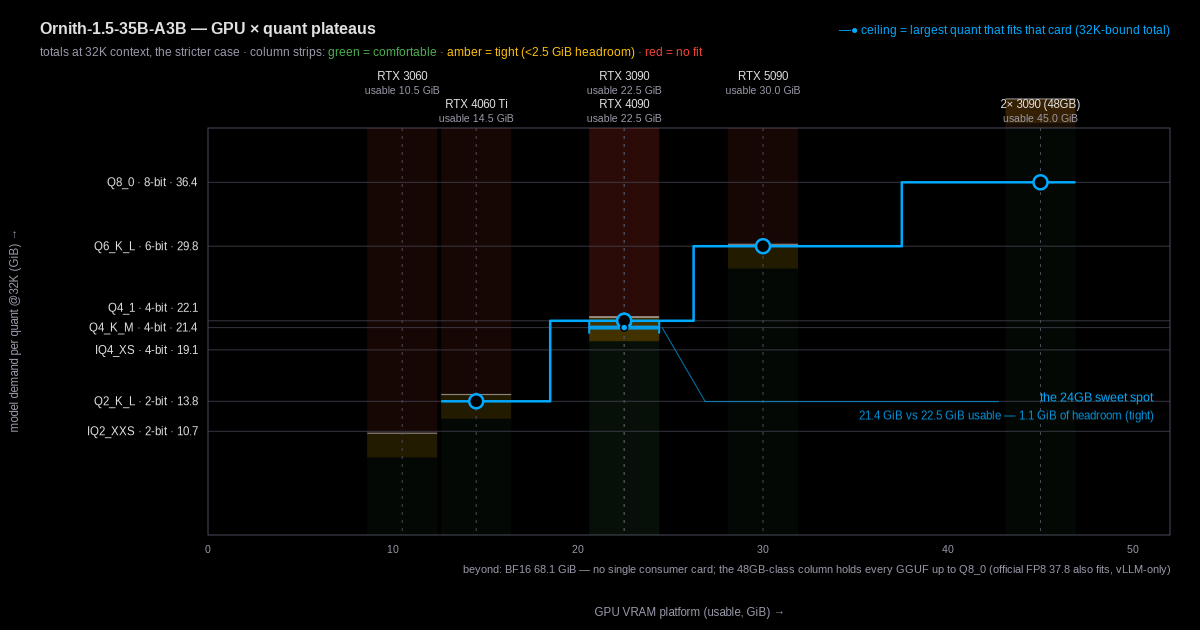
fits a 24GB card, tight — 1.1 GiB to spare · IQ4_XS is the comfortable 4-bit door (19.1, 3.4 spare); 32GB makes Q4_K_M comfortable (8.6)
Ornith-1.5-35B-A3B is a 35.95B-parameter hybrid MoE with 3.0B parameters active per token, and it needs 21.4 GiB at Q4_K_M, 32K context: 20.2 GiB of weights, 0.5 GiB overhead, and a 0.7 GiB KV bill. A 24GB card (22.5 usable) runs it with 1.1 GiB to spare — tight by this site's 2.5 GiB threshold — while a 32GB card leaves 8.6 GiB and is comfortable. The KV bill is small because only 10 of the 40 layers are full attention: 32K costs 0.7 GiB of cache where a plain 40-layer GQA model of this size would pay about 2.5 GiB. If you want comfortable 4-bit on 24GB, IQ4_XS totals 19.1 GiB with 3.4 GiB spare; the official Q8_0 build (36.4) is a 48GB-class ask.
Prepared by LLM VRAM · build · weights measured at pinned revisions, context and overhead explicit · sources below
Ornith-1.5-35B-A3B-Q4_K_M.gguf from ornith-ai's official GGUF repo (pinned, 20.22 GiB) and load it in llama.cpp or LM Studio — a 24GB card holds the full 32K context with 1.1 GiB to spare (tight), a 32GB card with 8.6. At 4K the same build is 20.9 GiB. For image input add the mmproj pack (0.84 GiB BF16) from the same repo.Ornith-1.5-35B-A3B is a 35.95B-parameter hybrid mixture-of-experts from Ornith-ai, released 2026-08-18 under MIT (declared in the model card's front matter and the repository's license tag — the pinned repository contains no LICENSE file), with 3.0B parameters active per token: 40 layers, of which 10 are full-attention GQA — just 2 KV heads, head dim 256 (config.json) — and 30 are GatedDeltaNet linear-attention layers with a fixed fp32 recurrent state. Native context is 262,144 tokens. The two design choices compound: sparse activation keeps the compute budget near a 3B model's, and the linear layers keep the 32K cache bill at 0.7 GiB — so the VRAM question is set almost entirely by weight size, which is why the 24GB door is tight at Q4_K_M and the 32GB door is not.
Page built · each pinned source carries its own access date in Where every number comes from
How much VRAM at each quantization? (weights + overhead + 4K KV, batch 1)
| Quantization | VRAM needed @4K | Total @32K | KV @32K provisional i · beyond the @4K column | Smallest tracked fit (context noted) | Note |
|---|---|---|---|---|---|
| IQ2_XXS | 10.2 GiB | 10.7 GiB | 0.6836 GiB | RTX 3060 12GB · ≤~20K ctx | measured weights · at 32K incl. KV: 10.7 GiB |
| Q2_K_L | 13.3 GiB | 13.8 GiB | 0.6836 GiB | RTX 4060 Ti 16GB | measured weights · at 32K incl. KV: 13.8 GiB |
| IQ4_XS | 18.6 GiB | 19.1 GiB | 0.6836 GiB | RTX 3090 24GB | measured weights · at 32K incl. KV: 19.1 GiB |
| Q4_K_M | 20.9 GiB | 21.4 GiB | 0.6836 GiB | RTX 3090 24GB | measured weights · at 32K incl. KV: 21.4 GiB |
| Q4_1 | 21.5 GiB | 22.1 GiB | 0.6836 GiB | RTX 3090 24GB | measured weights · at 32K incl. KV: 22.1 GiB |
| Q6_K_L | 29.3 GiB | 29.8 GiB | 0.6836 GiB | RTX 5090 32GB | measured weights · at 32K incl. KV: 29.8 GiB |
| Q8_0 | 35.8 GiB | 36.4 GiB | 0.6836 GiB | 2× RTX 3090 24GB (48GB aggregate) | measured weights · at 32K incl. KV: 36.4 GiB |
| BF16 | 67.6 GiB | 68.1 GiB | 0.6836 GiB | — | measured weights · at 32K incl. KV: 68.1 GiB |
GB vs GiB: card names are the manufacturer's nominal GB; totals here are GiB (230 bytes) — a "24GB" card holds 24 GiB. The official Q4_K_M file is 21,713,463,040 B = 21.71 GB (decimal download size) = 20.2 GiB. Caliber →
The 48GB-class doors, spelled out: a dual-GPU combo (2× 24GB; not one card doubled), a workstation card (RTX 6000 Ada), or a Mac Studio (unified memory; runs, slower tok/s). On this model that tier buys two things over 32GB: the official Q8_0 build (36.4 GiB) and, if you serve with vLLM, the official FP8 weights (37.8 GiB) — everything smaller already fits a single 32GB card.
How this page computes the numbers (reproduce any cell)
- usable VRAM = nominal minus reserve, per card: 12GB → 10.5 GiB, 16GB → 14.5 GiB, 24GB → 22.5 GiB, 32GB → 30.0 GiB, 2× RTX 3090 24GB (48GB aggregate) → 45.0 GiB.
- total@32K = listed file size + provisional runtime allowance + KV@32K; KV@32K = 0.6836 GiB (config-derived stacked upper bound — 22,400 B/token effective at 32K; actual ≤ value, composition in sources)
- total@4K (main column) = total@32K − (KV@32K − 0.0585938) × 7/8 — the constant state (0.0585938 GiB on this hybrid) is not scaled down at shorter context; only the linear part divides by eight.
- The "≤~XK ctx" note = 8K + 32K × (usable − total@8K) ÷ KV@32K — the context length that exactly fills the card (KV grows linearly with context on this model).
- A build fits a card at 32K when total@32K ≤ usable; tight = under 2.5 GiB of headroom, one site-wide threshold.
Is your GPU enough? (find your card: one row tells you)
| Your GPU | VRAM | Biggest quant that fits (ceiling) | How it feels |
|---|---|---|---|
| RTX 3060 12GB | 12 GB | — | — |
| RTX 4060 Ti 16GB | 16 GB | Q2_K_L (2-bit) · 13.8 GiB | 0.7 GiB spare at 32K (incl KV bound) |
| RTX 3090 24GB | 24 GB | Q4_1 (4-bit) · 22.1 GiB | 0.4 GiB spare at 32K (incl KV bound) |
| RTX 4090 24GB | 24 GB | Q4_1 (4-bit) · 22.1 GiB | 0.4 GiB spare at 32K (incl KV bound) |
| RTX 5090 32GB | 32 GB | Q6_K_L (6-bit) · 29.8 GiB | 0.2 GiB spare at 32K (incl KV bound) |
| 2× RTX 3090 24GB (48GB aggregate) | 48 GB | Q8_0 (8-bit) · 36.4 GiB | 8.6 GiB spare at 32K (incl KV bound) |
Quants stack by size: each GPU has exactly one ceiling — a card that runs a bigger build runs every smaller one. Main-column totals price the 4K load (weights + overhead + the KV term at 4K — the community runtime default); each row's Note prices the full 32K load this page promises (Q4_K_M at 32K = 21.4 GiB), and CPU offload trades tok/s for headroom.
What GPU should you buy for it? (the 24GB sweet spot logic)
| The logic | 24GB is the cheapest card that runs the standard 4-bit build at full 32K — Q4_K_M totals 21.4 GiB against 22.5 GiB usable, 1.1 GiB to spare. It is a tight door, not a comfortable one: if you want headroom at 4-bit on 24GB, take IQ4_XS (19.1, 3.4 spare). 32GB turns Q4_K_M comfortable with 8.6 GiB spare and is the only consumer single card that also holds the native 256K window at Q4 (25.8). Below 24GB you are in 2-bit territory at every rung. |
| Why it fits | The weights do the work: 20.2 GiB at Q4_K_M, and the hybrid KV bill adds only 0.7 GiB at 32K because 30 of the 40 layers never grow a cache. Compare a plain 40-layer GQA model of the same size — its 32K cache alone would be ~2.5 GiB, and the 24GB door would close. |
⚠ Tight is a site-wide threshold: under 2.5 GiB of headroom. Q4_K_M @32K leaves 1.1 GiB on a 24GB card, so the hero verdict is tight — the honest reading is "it runs, with nothing spare". The comfortable 24GB configuration is IQ4_XS (3.4 spare); the comfortable Q4_K_M configuration is 32GB (8.6 spare).
Tracked builds (actual file sizes, not theory)
| Build | Publisher | File size | 24GB @32K | Source |
|---|---|---|---|---|
| IQ2_XXS | bartowski | 9.6 GiB | OK · 10.7 | HF @64b0493d verified |
| Q2_K_L | bartowski | 12.6 GiB | OK · 13.8 | HF @64b0493d verified |
| IQ4_XS | bartowski | 18.0 GiB | OK · 19.1 | HF @64b0493d verified |
| Q4_K_M | ornith-ai | 20.2 GiB | TIGHT · 21.4 | HF @12393612 verified |
| Q4_1 | bartowski | 20.9 GiB | TIGHT · 22.1 | HF @64b0493d verified |
| Q6_K_L | bartowski | 28.7 GiB | NO · 29.8 | HF @64b0493d verified |
| Q8_0 | ornith-ai | 35.2 GiB | NO · 36.4 | HF @12393612 verified |
| FP8 | ornith-ai | 36.7 GiB | NO · 37.8 | HF @b93dbd81 verified |
| BF16 | ornith-ai | 67.0 GiB | NO · 68.1 | HF @10fbf86f verified |
Same quant name, different builds: Q4_K_M through Q6_K exist in ornith-ai's official repo and in bartowski's 27-quant ladder as separate builds — different publishers, repos and file bytes — and the table cites the official file as a display choice; the bartowski builds stay in the candidate universe. BF16 is three independent builds — bartowski's GGUF conversion (66.2 GiB), the official GGUF (66.2 GiB) and the official safetensors (67.0 GiB) — of which the row shown is the official build (display choice); none of the three fits a single consumer card. The official FP8 build (36.7 GiB weights) is vLLM-only; the MLX builds are Apple-only.
Self-host or API?
Estimate owned-GPU vs API breakeven
This is a token-cost sensitivity exercise, not a purchase recommendation. The model still has to meet your quality and throughput needs.
Worked example: a $1,200 GPU kept 30 months plus 350W for 4 hours/day at $0.15/kWh costs about $46 per month. At a blended API price of $0.50/1M, breakeven is about 93M tokens/month. Replace every input with your own numbers.
| Input | Value |
|---|---|
Monthly cost $46 · Breakeven tokens/month 93M
The static defaults and the script use the same formula. Nothing leaves this page.
Formula and evidence
| Monthly hardware cost | GPU price ÷ months you keep it |
| Monthly electricity | average watts × hours/day × 30 ÷ 1000 × your kWh price |
| Breakeven usage | (hardware + electricity) ÷ blended API price per 1M tokens |
No OpenRouter listing was found in the 2026-10-31 models API. The $0.50 blended input is an editable example, not a provider quote. The $1,200 GPU input is an editable example, not a market quote. Check the live provider page before committing budget. OpenRouter model search
Where every number comes from (every figure carries its tag)
Totals: measured weights + the hybrid KV bill (10 full-attention layers grow with context, 30 GatedDeltaNet layers hold a fixed state — config-derived and labeled) + borrowed provisional overhead allowance. This page exists for one config: the 35B-A3B hybrid MoE × Q4_K-class quant × 32K context — the rung where 24GB stops being comfortable and 32GB starts being the answer.
| Tag | Slot | What it is | What the verdict can claim |
|---|---|---|---|
| reported | model | Hugging Face config.json @10fbf86f (identity carrier: 40 layers = 10 full-attention + 30 GatedDeltaNet, 2 KV heads, head dim 256, 262,144 max positions — the source of every architecture and KV figure on this page) | Tight, conditional — stands on the linked source, re-checkable by you. |
| reported | static | Hugging Face model page (ornith-ai/Ornith-1.5-35B-A3B, pinned README: publisher benchmark table and vLLM / SGLang / Transformers serving recipes) | Tight, conditional — stands on the linked source, re-checkable by you. |
| measured | static | Official GGUF tree @12393612 (5 single-file quants, byte sizes read from the pinned listing: Q4_K_M 21,713,463,040 B · Q5_K_M 25,347,532,544 B · Q6_K 29,208,731,392 B · Q8_0 37,802,149,280 B · BF16 71,066,994,400 B; the mmproj vision projector, 902,822,240 B, is excluded from model weights) | Pinned fact — the file measurement is checkable; runtime is not measured. |
| measured | static | bartowski GGUF tree @64b0493d (27 single-file quants, the community ladder: IQ2_XXS 10,255,140,512 B · Q2_K_L 13,582,419,616 B · IQ4_XS 19,278,554,784 B · Q4_1 22,447,449,760 B · Q6_K_L 30,772,643,488 B) | Pinned fact — the file measurement is checkable; runtime is not measured. |
| measured | static | Official safetensors tree @10fbf86f (71,903,871,064 B = 67.0 GiB BF16 — the source of the parameter count and of the 3.0B active-parameter figure). BF16 exists as three independent builds — this safetensors file set, the official GGUF conversion (71,066,994,400 B = 66.2 GiB, ornith-ai GGUF repo @12393612) and bartowski's GGUF conversion (71,066,994,208 B = 66.2 GiB, bartowski repo @64b0493d) — different repos and file sets, never merged by any percentage threshold; the BF16 row on this page shows the official safetensors build as a display choice, and all three stay in the candidate universe | Pinned fact — the file measurement is checkable; runtime is not measured. |
| provisional | kv | KV cache @32K — 0.6836 GiB, config-derived: 10 full-attention layers × 2 KV heads × 256 dim × K/V × 2 bytes = 20,480 B/token × 32,768 tokens = 0.625 GiB, plus a fixed fp32 recurrent state of 0.058594 GiB for the 30 GatedDeltaNet layers. No published measurement; actual ≤ value | Very likely right, order of magnitude only — replaced the moment measured values land. |
| provisional | overhead | Deployment overhead — borrowed allowance from a Gemma 2 9B / 4K / FA-off log (507 MiB; provisional, not measured on this model) | Very likely right, order of magnitude only — replaced the moment measured values land. |
FAQ
Does Ornith-1.5-35B-A3B fit in 24GB VRAM?
Yes, but tight. At the page's full 32K context the Q4_K_M build totals 21.4 GiB (20.2 GiB weights + 0.5 GiB overhead + a 0.7 GiB hybrid KV bill), leaving 1.1 GiB free on a 24GB card — under this site's 2.5 GiB comfort line. If you want comfortable 4-bit on 24GB, IQ4_XS totals 19.1 GiB with 3.4 GiB spare; if you want Q4_K_M comfortable, 32GB gives 8.6 GiB. At 4K context the same Q4_K_M config is 20.9 GiB, still tight.
How much VRAM does Ornith-1.5-35B-A3B need at Q4_K_M?
21.4 GiB at 32K context: 20.2 GiB weights (official GGUF file at a pinned revision), 0.5 GiB runtime overhead, 0.7 GiB KV cache. The KV bill stays small because the model is hybrid — only 10 of its 40 layers are full attention, growing at 20,480 bytes per token, so 32K tokens cost 0.63 GiB while the other 30 layers are GatedDeltaNet linear attention with a fixed fp32 state (0.06 GiB) that does not grow with context. Sparse activation is the other half: 3.0B of the 35.95B parameters are active per token, so throughput comes closer to a 3B model's while the weights stay 35B-sized.
Can Ornith-1.5-35B-A3B run on a 12GB or 16GB card?
Not on 12GB — the smallest tracked build, IQ2_XXS, totals 10.7 GiB at 32K against 10.5 GiB usable, missing by 0.2 GiB (a lower-bit community quant or a shorter context would have to close that gap). On 16GB the door is Q2_K_L at 13.8 GiB, tight at 0.7 GiB spare; Q2_K at 13.4 gives a little more room but is a coarser 2-bit. This is a 24GB-class model: below that you are trading quality hard for a small saving.
Can Ornith-1.5-35B-A3B run its full 256K context?
On a 32GB card, yes — comfortably. At the native 262,144-token window the attention cache grows to 5.0 GiB, so the Q4_K_M config totals 25.8 GiB: 4.2 GiB of headroom on a 32GB card, and 3.3 GiB over a 24GB card's usable VRAM. To hold 256K at Q4 on 24GB you would need a build about 3 GiB smaller (Q4_K_S totals 20.8 at 32K but still 25.2 at 256K — the cache, not the weights, is the binding term at that length). This page prices 32K because that is the config people run; the full window is a hardware step.
Which Ornith-1.5-35B-A3B file should I download?
The official Q4_K_M GGUF from ornith-ai's repo — 21,713,463,040 B (21.71 GB, 20.2 GiB) — is the cleanest default; bartowski's 27-quant ladder covers the odd sizes (IQ2_XXS up to Q6_K_L) the official repo skips; same-name files in the two repos are different builds (different publishers, repos and bytes), and this page cites the official file as the display choice. BF16 is three independent builds in the universe — bartowski's GGUF conversion (66.2 GiB), the official GGUF (66.2 GiB) and the official safetensors (67.0 GiB) — and the row shown is the official build; none of the three fits a single consumer card. For image input add the mmproj projector (0.84 GiB BF16) from either repo.
Can Ornith-1.5-35B-A3B run on a Mac?
Yes. ornith-ai ships MLX 4-bit (19.4 GiB at 32K) and MLX 8-bit (35.5 GiB at 32K) conversions, and on Apple silicon the GPU ladder's 24GB column applies to unified memory too — MLX-4bit at 19.4 GiB fits a 24GB Mac with 3.2 GiB to spare, and MLX-8bit is a 48GB-class ask. Two caveats the model card does not settle: unified-memory bandwidth sets token rate, not the fit, and long-context Apple runs are the least-measured configuration on this page (the KV figure stays config-derived either way).
How does this site compute these VRAM numbers?
Weights are measured file sizes at pinned revisions (sources below); totals add runtime overhead plus the KV cache at 32K context. Here KV@32K = 0.6836 GiB = 20,480 B/token × 32,768 tokens (10 full-attention layers × 2 KV heads × 256 dim, config-derived bound) plus 0.06 GiB of fixed state for the 30 linear layers. A build fits a card at 32K when the total clears usable VRAM (nominal minus reserve), and tight means under 2.5 GiB of headroom — the full formula lives in the method box under the quantization table.